

Sun to Moon: A Day-and-Night Story Activity with MagFlake Magnetic Tiles
Back to Journal News

Give one small scene two moments
Some afternoons, the build table has the energy of a tiny airport: somebody has parked a triangle where the snack bowl belongs. Instead of starting another giant castle, give one small scene two moments. Build a daytime corner with the MagFlake set, place the single sun face where everyone can see it, and let a short story begin. When the characters are ready for a change, pause, bring in the one crescent moon, and turn the same scene into night. A single star can join in if it helps the story, but no astronomy homework is required.
This works on a kitchen table, a tray, or one calm patch of floor. Choose a few grass pieces, a flower or shrub-like piece, and just enough squares and triangles for a low backdrop. Keep the scene easy to reach. Pieces may lean or decide to become a new setting halfway through. That is not a problem; it is the plot. For Ages 3+, follow the current product label and instructions.
Pull out only a small scene-making group of pieces:
| Scene role | Pieces to consider |
|---|---|
| Day and night markers | One sun face and one crescent moon |
| Optional nighttime detail | One star |
| Ground and garden details | A few grass or turf pieces, one or two flowers, and a shrub or tree-like piece |
| Building structure | A few four-slot square pieces and a few triangular pieces |
| Story character | The lion or the bird |
| Optional daytime sky detail | One white cloud piece |
Keeping most of the set nearby but not scattered across the whole table helps the activity stay calm. A small cleared area is enough. If a child wants to build on the floor, choose one reachable zone rather than stretching the scene across a traffic lane. Nobody needs to step over a moon on the way to stir pasta.
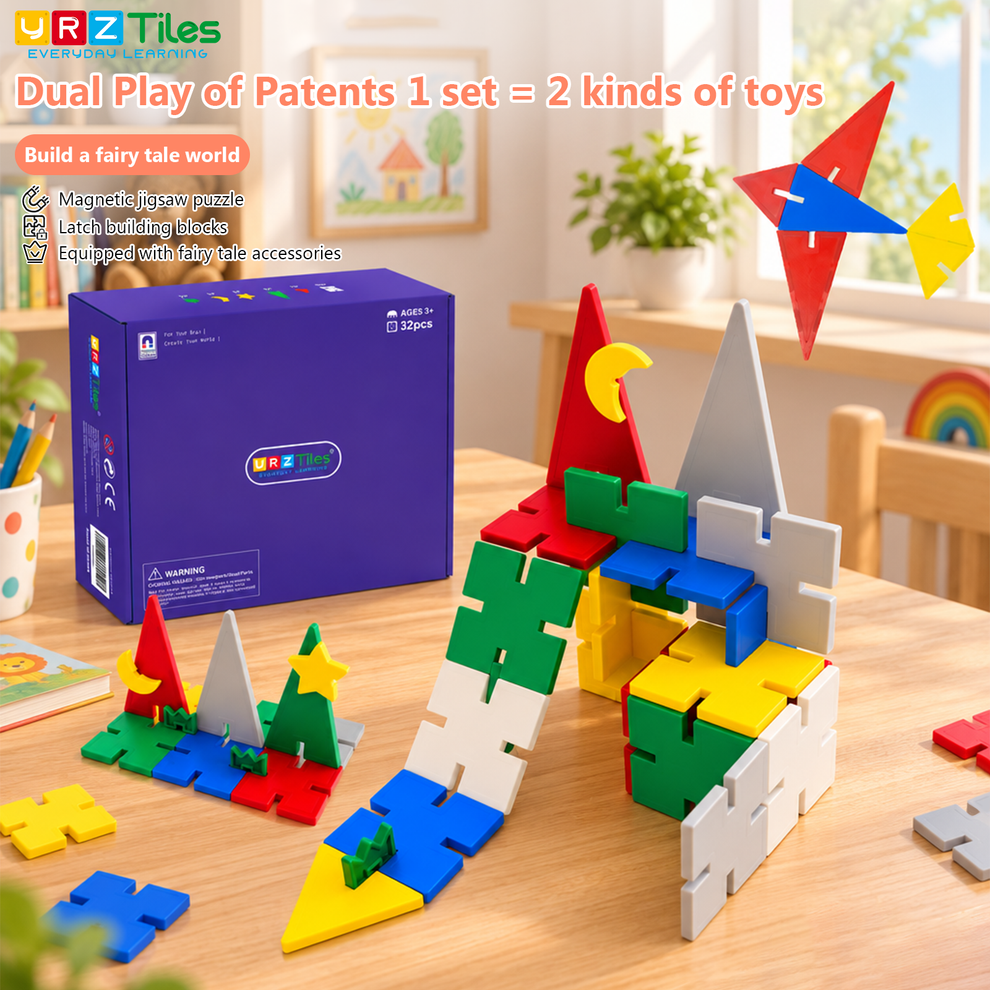
A MagFlake 58 piece magnetic tile garden build can stay very simple. Use grass or turf as a ground line, place a flower near a shrub or tree-like piece, and add enough squares and triangles to suggest a low border or backdrop. If gardens are not today's plan, the same selection can become a sheltered corner for the lion, a resting spot for the bird, or a frame that says, "The story happens here."
The set combines edge-to-edge magnetic building with slot-based interlocking. Try connecting or positioning pieces where the set's compatible connection allows. You do not need to use every available connection or make every piece stand upright. A flat scene can be just as inviting as a standing one.
Build the daytime scene before the story gets complicated
Start low. A few square pieces can make a small base, wall, or backdrop. Add one or two triangular pieces as a roof-like point, a hill-like detail, or a directional edge. Separate rigid pieces can be arranged at different angles to change the direction of the scene. There is no need to force a curve when a gentle turn made from a few pieces will do.
Choose one of these small daytime settings.
A garden edge
For a garden, arrange grass or turf pieces along the bottom of the scene. Add flowers and a shrub or tree-like piece. Place the bird nearby if it fits the story. The daytime event might be as simple as this: the bird is looking for a quiet place before the sky changes.
Put the sun face where it clearly reads as daytime. You can attach or position it where the compatible connection allows, or place it beside the scene as the story marker. The important part is that everyone can see the day has begun.
A low lion den
A MagFlake magnetic tile lion den building activity does not need a tall cave. A low shelter made from a few squares and triangles can be enough for the story. Add grass or turf and a shrub or tree-like piece near the edge. Place the lion close to the den instead of making the character carry any part of the build.
The daytime problem can be small and story-friendly: the lion wants a shaded corner before evening. Maybe the first roof is lopsided. That is not a design emergency. It is simply the den's first draft.
A high and low bird setting
For a MagFlake magnetic tile bird nest high low structures variation, make a low ground area and a modest raised section if the arrangement feels steady. The bird can begin near the upper area, then move lower when nighttime arrives. If the raised idea does not work, make a ground-level resting place. A bird can have a very excellent nest that is only one tile high, especially when dinner is approaching.
A simple story frame
A MagFlake magnetic tile story frame activity can be even more compact. Make a square-and-triangle backdrop with grass or turf at the bottom. Add one character, one sky marker, and one setting detail. This is useful when siblings are sharing because there is less debate over who gets the "good wall."
Before the story moves forward, take a quick look from the side. Does the scene feel easy to reach? Is one part leaning? Does a triangle look better somewhere else? Small changes now can keep the next chapter from becoming a full rescue mission.
Change the scene with a MagFlake magnetic tiles sun and moon story activity
Once the daytime scene feels ready, let the story pause. The bird may be deciding where to rest. The lion may be heading back to the den. The garden may simply be getting quieter.
Now make the central switch:
- Remove or reposition the sun face.
- Bring in the crescent moon.
- Attach or position the moon where the set's compatible connection allows, or place it beside the build as the night marker.
- Add the one documented star only if your family wants that single nighttime detail.
- Decide what changes after dark.
The scene does not need to become a totally new build. In fact, keeping most of it the same is the point. The moon tells everyone that time has passed, while the familiar garden, den, perch, or frame gives the story a place to continue.
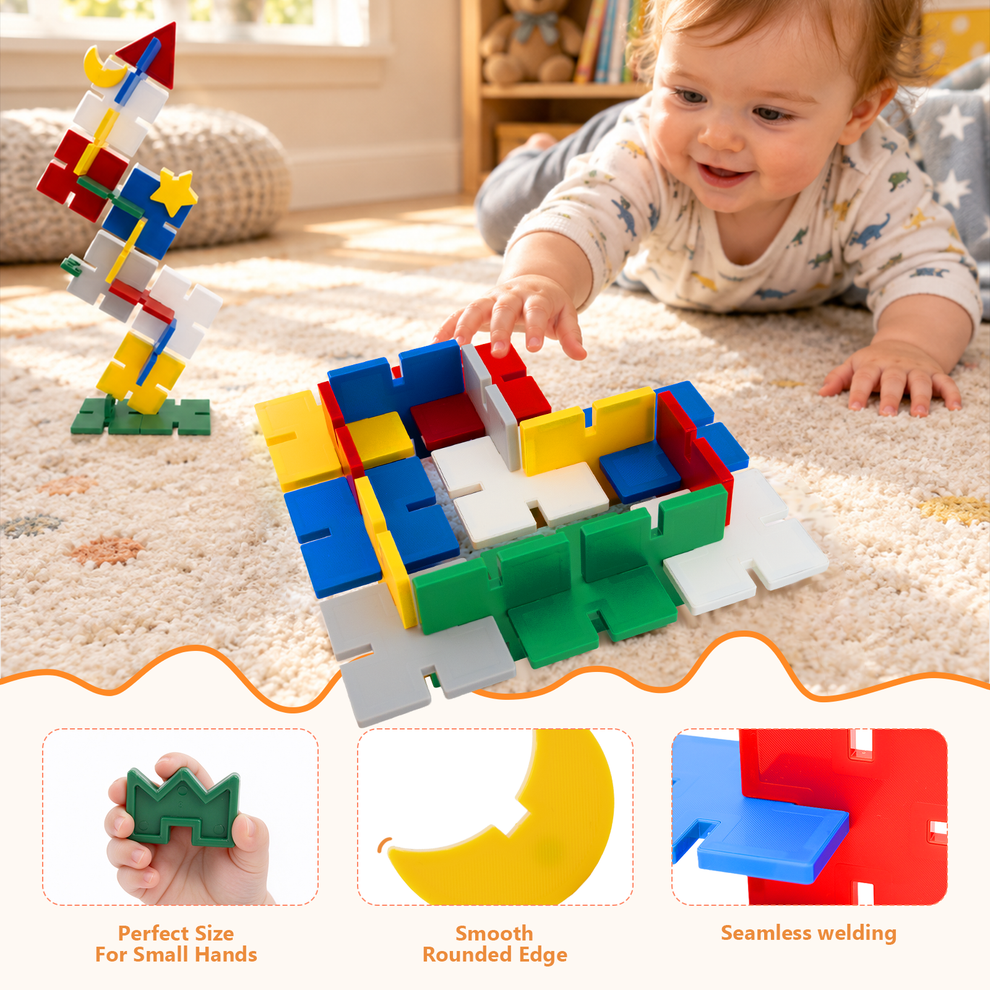
A night change can be gentle:
- The bird moves from a higher perch to a lower resting place.
- The lion returns to the sheltered corner.
- One flower becomes part of a quiet garden scene.
- The cloud piece is moved away, or simply no longer matters to the story.
- A tall daytime idea becomes a low nighttime den.
- The scene becomes flatter because the characters are ready to rest.
This is a MagFlake magnetic tile animal habitat building prompt, not a test of how much structure the scene can hold. If a child decides the garden is now a lion's hideout, follow that idea. If the lion becomes the guardian of the bird's resting place, that works too. Play plans change quickly, often right after someone has carefully explained the plan in great detail.
Use a MagFlake magnetic tile three sentence story prompt
Once the moon is in place, the build becomes an easy invitation to pretend play. You do not need a long script, a special voice, or a dramatic narrator who sounds like they are auditioning for a wildlife documentary.
Try this MagFlake magnetic tile three sentence story prompt:
- "When the sun was up, the ___ was trying to ___."
- "Then the sky changed, and ___ happened."
- "Under the crescent moon, the ___ decided to ___."
For example:
- "When the sun was up, the bird was trying to find a garden perch."
- "Then the sky changed, and the bird heard the lion near the den."
- "Under the crescent moon, the bird decided to rest close to the tree-like piece."
Let children supply silly, surprising, or very practical answers. Maybe the lion is looking for a flower. Maybe the bird is organizing a nighttime garden inspection. Maybe the moon arrives early because the child says it is "already dark in the story." That is perfectly reasonable story logic.
For siblings, divide the story rather than the whole build. One child chooses the daytime problem. Another chooses what changes when the moon arrives. A third person, including an adult or grandparent, can choose the ending. If two children want different nighttime endings, tell both. The same scene can have two endings without anyone having to declare a winner.
Adults can join with one open question: "What changed when the moon came out?" Then pause. A quiet pause often gives children room to notice something new, move a piece, or take the story in a direction no adult would have predicted.
Troubleshoot the rebuild without calling it a mistake
Magnetic tile play has a wonderful habit of changing course. The original garden becomes a den. The bird's perch becomes a pointy mountain. A careful wall falls over because an elbow had important business elsewhere. Treat these moments as part of the activity.
| If this happens | Try this next |
|---|---|
| The structure leans | Lower the tallest section, widen the base with available square pieces, or turn the scene into a flatter setting. |
| A connection does not sit as expected | Separate the pieces, rotate one, and try a different arrangement. If it still does not suit the scene, give that piece a new role. |
| Pieces run low | Make the story smaller. The garden can be a tiny secret corner, and the den can be hidden behind one low wall. |
| The build falls | Keep one piece that matters to the story, then rebuild only the part needed for the next moment. |
| Siblings disagree | Give each person one decision: day problem, night change, or ending. |
| Space is limited | Use a low arrangement within one reach zone rather than a wide landscape or tall structure. |
| There are only a few minutes left | Use the sun, moon, one character, one landscape detail, and a few building pieces. Three sentences are still enough. |
A successful activity does not require the daytime and nighttime scenes to match exactly. Maybe the daytime build has a small raised perch, but the nighttime scene becomes a low den after a piece is moved. That is not failure. It is a visible story change.
If a structure is crowded, remove one decoration before adding another. If a triangle seems determined to be somewhere else, let it go somewhere else. The pieces are not grading the architecture.
Reset the scene for another day
Cleanup can be the final part of the story instead of an abrupt announcement that play is over. The moon leaves the scene. The garden pieces return to their group. The building pieces wait for another setting tomorrow.
A simple reset works well:
- Put the sun, crescent moon, and optional star together as sky pieces.
- Group the lion, bird, grass or turf, flowers, and shrub or tree-like pieces as scene pieces.
- Return squares and triangles as building pieces.
- Count only if counting is already part of your family's regular routine.
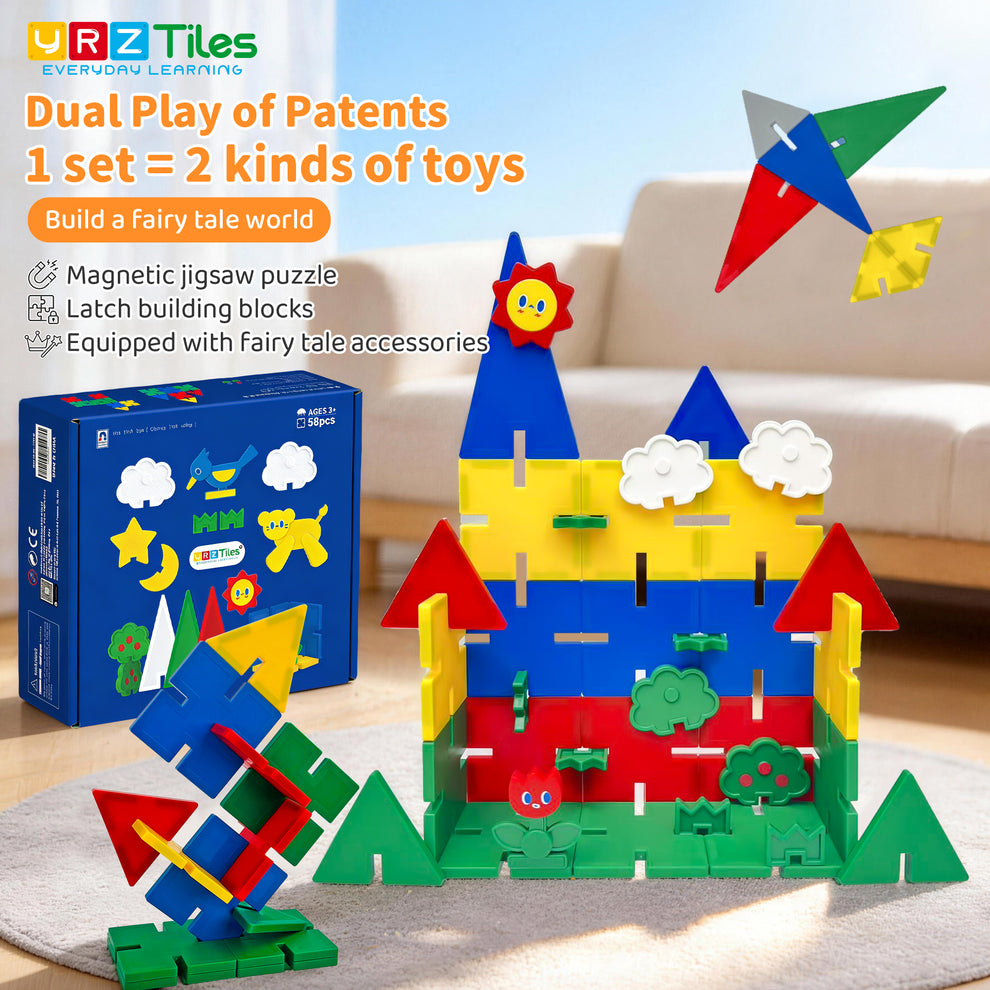
Families who want the documented sun face, crescent moon, landscape-style pieces, animal characters, squares, and triangles used in this activity can explore the MagFlake 2 in 1 Magnetic Tiles 58-Piece Set.
One small daytime scene can become a nighttime story without taking over the room or requiring a brand-new plan. Build a place, let the sun shine, bring in the moon, and see what changes. If the roof leans, the bird relocates, or the lion suddenly runs the garden, the story is doing exactly what it should.
Comments
No comments yet. Be the first!