

Magnetic Tiles for Kids: A Complete Guide for Parents
Magnetic tiles are open-ended building pieces that connect along their edges. Children can lay them flat to make patterns, lift them into walls, or combine both approaches to create houses, towers, bridges, vehicles, and pretend-play settings. The appeal is that the same pieces can support a short five-minute challenge or a longer family project. There is no single correct model, so children can plan, test, notice a problem, and try again.
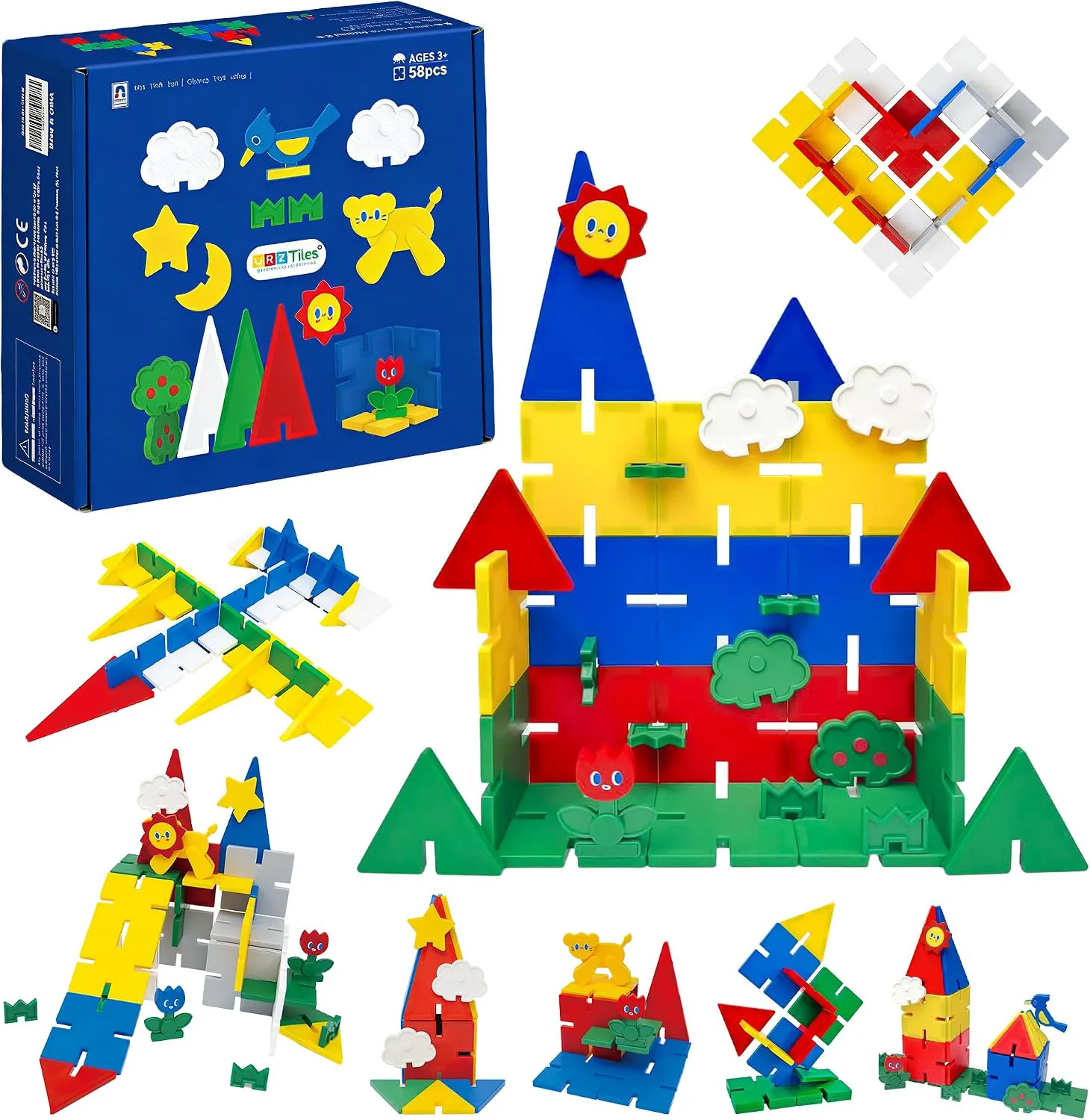
For parents, the most useful question is not whether a magnetic tile set is universally the best toy. It is whether a particular set fits the child's age, interests, play space, storage routine, and the number of people who will use it. This guide explains how to compare sets, introduce the pieces, choose safe activities, and decide when a larger or different set makes sense.
What magnetic tiles can support
Magnetic tiles can be used for several kinds of play:
- Shape and color exploration: Children sort pieces, match shapes, make repeating patterns, and describe corners, sides, and angles.
- Flat design: A child can create a butterfly, fish, rocket, flower, geometric picture, or symmetrical mosaic on a floor or table.
- Three-dimensional construction: Connected pieces can become an open house, a low tower, a bridge, a shop, or an animal shelter.
- Story and pretend play: A structure gives a story a setting. Children can decide who lives there, what happens, and how the setting changes.
- Collaborative building: Two or more builders can divide pieces, take turns, or give each other verbal instructions.
- Simple engineering questions: Children can compare a wide base with a narrow base, test a short bridge, or rebuild a structure after it wobbles.
These are opportunities created by hands-on construction, not guaranteed developmental results. A child's experience depends on age, interest, support, and the condition and design of the actual set.
How to compare set sizes
Piece count changes the scale and sharing experience, but it does not tell the whole story. A compact set can be easier for a first-time builder to sort and clean up. A larger set gives siblings more pieces to use at the same time and leaves more material for large buildings.
YRZtiles currently lists these official products:
| Set | Best starting point | Important boundary |
|---|---|---|
| 32-piece Classic set | Short activities, travel-sized play, one child, or a first introduction | The official page does not provide a reliable shape-by-shape inventory, so do not promise specific quantities. |
| 100-piece Classic set | Larger homes, shared builds, classrooms, and projects that use many standard pieces | The official page does not confirm that it includes the 106-piece set's special windows, doors, or chassis. |
| 106-piece Classic set | Architecture, detailed scenes, and vehicle builds | The verified set includes architectural pieces and one wheeled chassis; one chassis does not make several vehicles at once. |
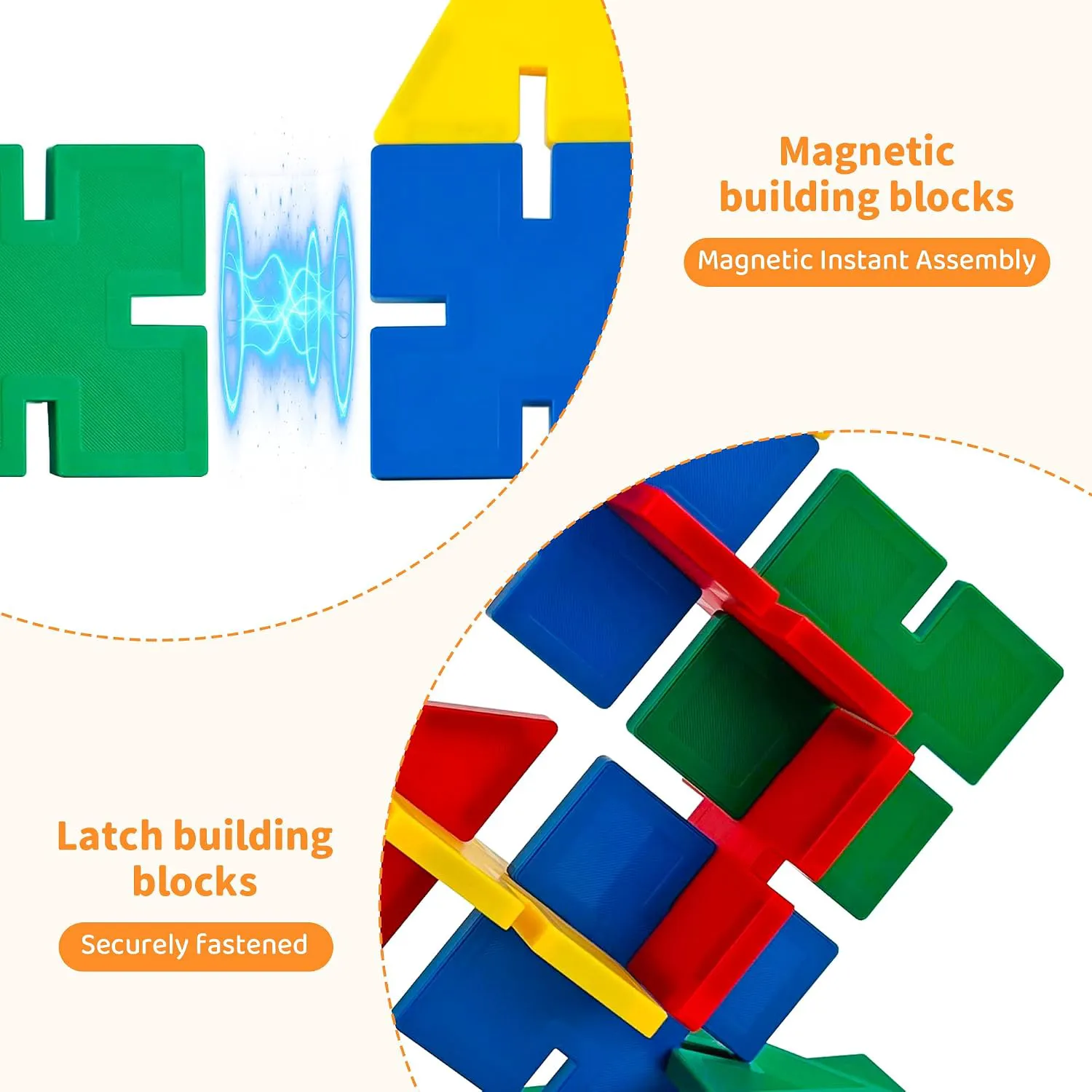
| 58-piece MagFlake set | Families who want a separate magnetic and slot-interlocking building format with themed pieces | Treat MagFlake as its own system. Do not assume that every other brand or product line connects securely. |
The 106-piece set is the easiest choice when a child is specifically interested in windows, doors, a garage, or a vehicle chassis. The 100-piece set may be a better fit when the goal is quantity for large conventional tile structures. The 32-piece set can be enough for patterns, compact buildings, and guided challenges. MagFlake is a format choice, not simply a smaller or larger Classic set.
A gentle progression for new builders
Start with a small number of pieces on a stable, clear surface. First ask the child to find two edges that connect naturally. Then try a flat pattern, such as an alternating color row or a simple butterfly. When the child is ready, lift one connected edge to make a wall. An open-sided structure is often easier to understand than a closed building.
Next, add a design question rather than a demand for a perfect model. Ask, “What could make the base wider?” or “Where could the doorway go?” If the structure falls, pause and let the child describe what changed. Rebuilding one section at a time turns a collapse into information without making the activity feel like a test.
For mixed-age play, give children different jobs. One child can sort colors, one can place the base, and another can describe the story. Rotate roles so the youngest participant is not limited to watching and the oldest participant is not expected to do every difficult connection.
Buying checklist for parents
Before ordering any magnetic tile set, check the exact product page and packaging. Look for:
- Age grade and warnings. The YRZtiles products reviewed for this guide are marked for ages 3+. That does not make a product suitable for every three-year-old. Consider mouthing behavior, younger siblings, and the manufacturer's instructions.
- Confirmed contents. Read the listed piece count and identify which shapes or special components are actually documented. Do not infer that a 100-piece set includes the 106-piece set's chassis.
- Play scale. Decide whether one child will build alone, whether siblings will share, or whether the set will be used by a small group. More builders usually need more pieces and a clear turn-taking plan.
- Storage. A lidded container or designated bin makes it easier to count pieces and keep them away from children below the stated age range.
- Condition checks. Choose a routine that lets an adult inspect seams, edges, and magnet enclosures before play and during cleanup.
- Product-specific care guidance. Do not assume that magnetic tiles are dishwasher-safe, waterproof, or suitable for outdoor storage. Follow the exact instructions supplied with the product.
- Compatibility. Do not assume that pieces from different brands or systems will connect, hold weight, or be safe together. Compatibility should be documented for the exact products.
Safety and supervision
Magnetic toys need regular inspection. Stop using a piece if it is cracked, split, rattling, missing a section, has a sharp edge, or appears to expose a magnet. Do not tape, glue, drill, or otherwise repair a damaged tile for continued child use. Place questionable pieces in an adult-controlled container and keep them out of play until the manufacturer provides replacement or disposal guidance.
Children should not bite, chew, throw, or step on magnetic tiles. Do not build structures intended to carry a child's body weight. Keep loose accessories and small parts away from babies and children who are below the product's labeled age range. Count and gather every piece after play, especially when a set is used by siblings, classmates, or guests.
If a magnet may have been swallowed or inserted into the body, seek immediate medical attention. Do not wait for symptoms. The U.S. Consumer Product Safety Commission magnet guidance explains that swallowed magnets can attract through intestinal tissue and cause severe internal injury.
Easy first activities
Parents can begin with activities that have a clear limit:
- Use ten pieces to build the tallest free-standing tower that stays low enough for an adult to inspect.
- Make an AB color pattern, then ask the child to continue it.
- Build one side of a flat butterfly and make a mirror image.
- Use the 106-piece set's architectural pieces to design a doorway, window, or small shop.
- Use the single chassis in the 106-piece set to plan one vehicle, then redesign its body without implying that the chassis is a tested or load-rated part.
- With MagFlake, compare a flat pattern with a small slot-connected form and describe how the connection feels different.
The best activity is usually the one that leaves room for the child to make a decision. Offer one prompt, ask one thoughtful question, and let the finished model be the child's own.
Parent questions
How many magnetic tiles does a child need? There is no universal number. A small set can support patterns and compact structures. A larger set is more useful when siblings share pieces or when the child enjoys large buildings.
Are magnetic tiles safe for toddlers? Follow the exact age grade. The YRZtiles products reviewed here are marked 3+, so they should not be presented as products for children under three.
Can Classic tiles and MagFlake be mixed? They are separate product systems. Do not promise compatibility unless YRZtiles provides product-specific documentation.
What should I do when a piece breaks? Stop play, isolate the piece, check the area for loose components, and follow the manufacturer's replacement or disposal instructions. Seek urgent medical care if a magnet may have been swallowed.
Magnetic tiles work best when the product choice, the activity, and the supervision routine fit the real household. Start with verified information, bring out a manageable number of pieces, and let construction grow from the child's questions.