

Magnetic Edge or Interlocking Slot? How MagFlake Magnetic Tiles Connect
Back to Journal News

Some builds begin with a grand plan. Others begin with two pieces, one puzzled face, and a roof making a slow escape toward the fruit bowl. When that happens, the useful question is simple: should these pieces meet along their magnetic edges, or should a slotted building piece guide the next turn?
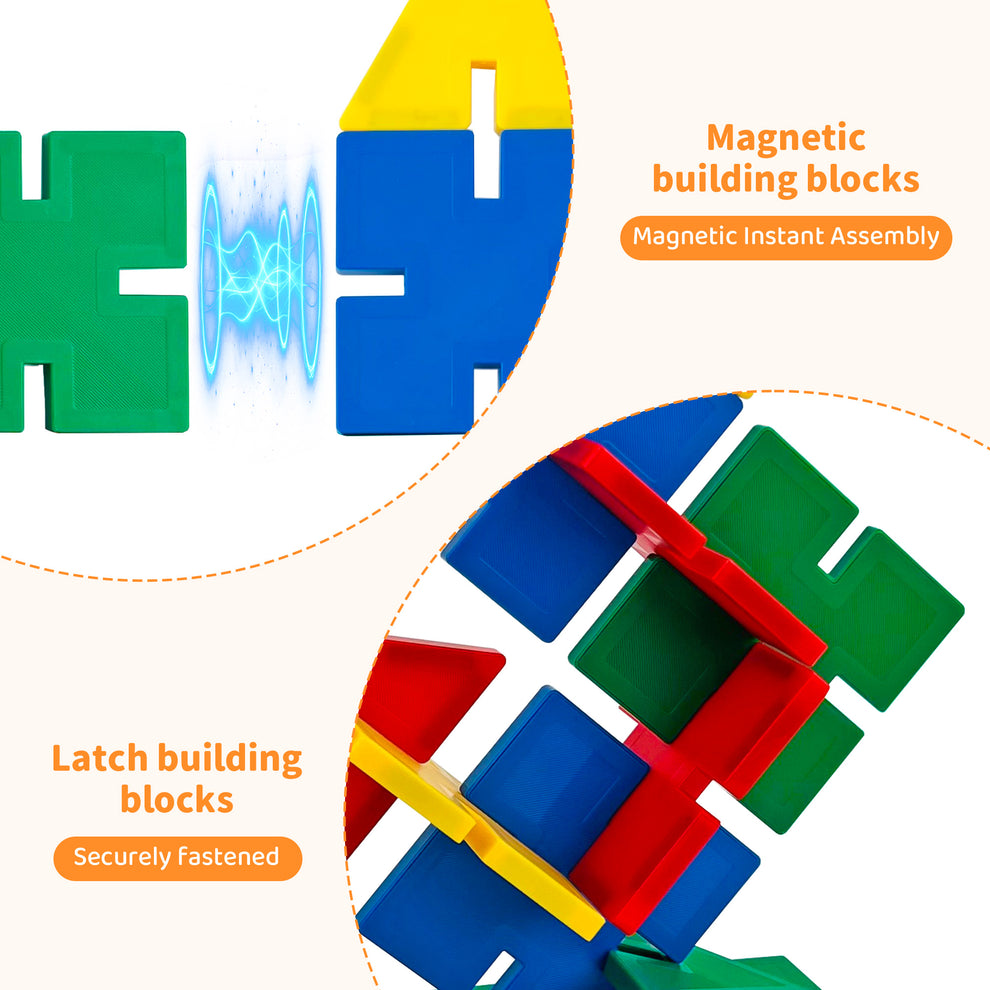
MagFlake supports both edge-to-edge magnetic connections and slot-based interlocking with its slotted building pieces. Think of them as two tools in the same small toolbox, not rival teams. Magnetic edges are handy when kids want to place, lift, and rearrange pieces quickly. Slots offer another way to join compatible building pieces when a child wants to set a particular angle or direction. Families can try one, switch to the other, or combine both as the idea changes - because children's blueprints have a charming habit of changing halfway through. Start with a few square and triangular pieces, leave room for small hands, and test each connection gently before adding more.
MagFlake magnetic tile edge vs interlocking slot: Choose the next move
Think of magnetic edges as a quick invitation to try an arrangement. Bring compatible building-piece edges together, look at the direction they create, and keep going if it suits the idea. This can be useful when a child wants to begin with a flat pattern, add a triangle to the top of a shape, or extend a small section without taking apart everything nearby.
Slot-based interlocking offers another route with the slotted building pieces. Choose two pieces with visible slots, line up a compatible arrangement, and see how the build changes. If the pieces do not sit the way you expected, rotate one, choose another pair, or return to an edge connection. It is not a test with one correct answer. It is a tiny experiment in the middle of play.
| If the next idea is... | A useful first try | What to do if it does not suit the plan |
|---|---|---|
| A flat picture or outline | Compatible edge-to-edge magnetic connection | Change the angle or use fewer pieces |
| A new direction in the build | Compatible slot-based interlocking | Rotate one slotted piece or try another pair |
| A raised side or roof-like top | Magnetic edges between compatible building pieces | Remove one top piece and make a simpler version |
| A sibling's add-on section | Either connection method that fits the next arrangement | Keep the sections separate until a compatible connection appears |
The most flexible approach is often both. A family might begin with magnetic edges to make a low flat outline, pause when a square building piece invites a slot experiment, then use magnetic edges again for the next section. The build does not need a blueprint. It needs somewhere interesting to go.
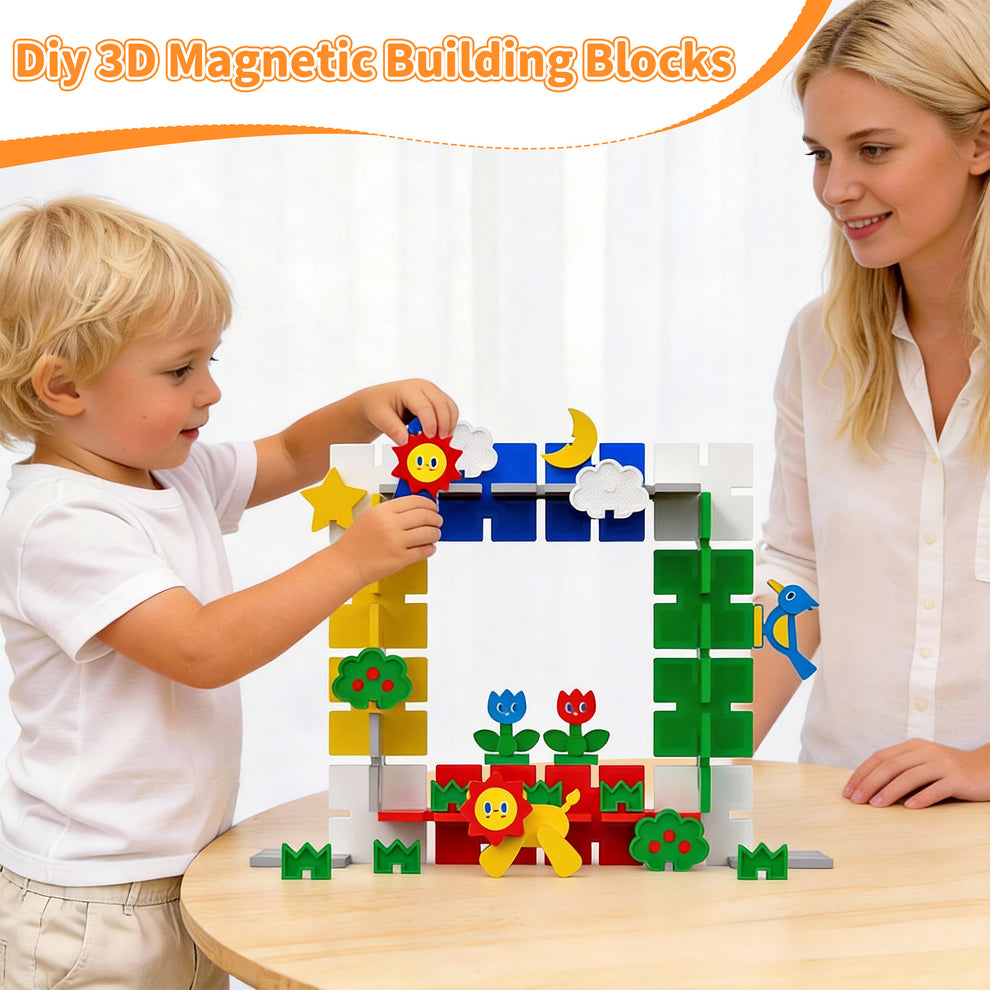
MagFlake magnetic tile slot and edge fine motor activity
Keep this short activity wonderfully small. Put out two to four four-slot square building pieces and one or two triangles. One person chooses an edge-to-edge connection. The next person tries a compatible slot-based interlocking connection. Then ask, "What does it look like now?"
Maybe it becomes a doorway-shaped outline. Maybe it looks more like a very determined sandwich. Either answer is acceptable.
The point is simply to notice that a connection choice changes the direction of the play. If the slot arrangement does not look right, separate the pieces and try another orientation. If the magnetic-edge arrangement starts a pattern instead of a building, let it be a pattern. A child does not need to defend the original plan to a panel of tiny construction inspectors.
MagFlake magnetic tile edge vs interlocking slot: Start flat, then go 3D
A flat arrangement is not merely a warm-up. It can be the whole activity, especially when floor space is limited or the table is already home to homework, snack crumbs, and a water bottle with a mysterious missing lid.
Start with four to six basic building pieces from the MagFlake 2 in 1 Magnetic Tiles 58-Piece Set. The documented inventory includes four-slot square building pieces along with shorter and longer triangular pieces, which gives families enough variety to make a simple outline without needing an elaborate plan.
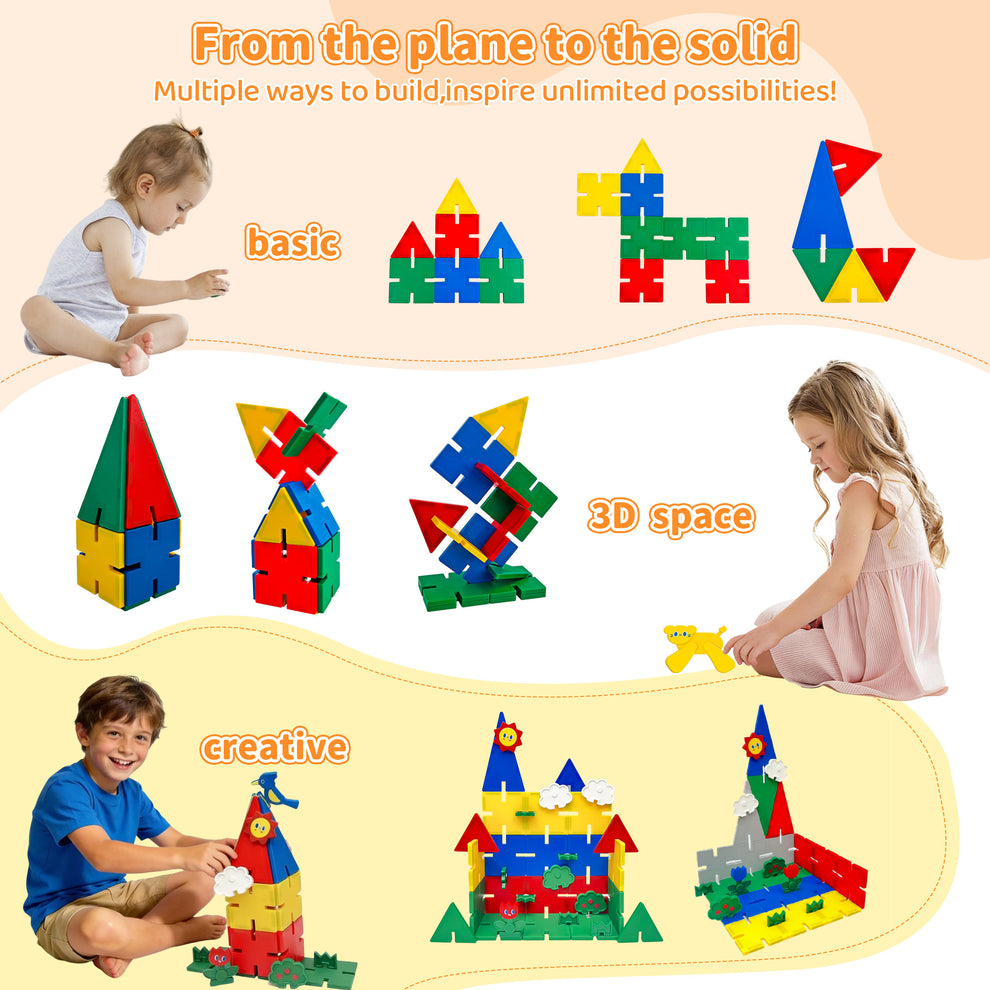
Lay squares and triangles into a flat arrangement using compatible magnetic edges. It might resemble a small room, a tent shape, a path, or something that has no name yet. Once the flat design feels interesting, lift one connected side and see whether it becomes the start of a 3D structure.
MagFlake magnetic tile flat pattern to 3D structure
Try this easy sequence:
- Make a small flat square-and-triangle pattern.
- Choose one connected side to lift.
- Add or remove a triangle if the shape begins to suggest a roof, cave, beak, or pointy mountain.
- Stop wherever the build looks satisfying.
There is no requirement to lift every side. A half-flat, half-raised creation can be more fun than a carefully closed shape, particularly when one child sees a house and another sees a creature cave. Let both stories have a turn.
If the raised section begins to lean, take off the highest piece first. Simplify the lower arrangement, then try again. You are not correcting a mistake. You are making the next version. Sometimes the most useful redesign is simply returning to a low, flat scene that is ready for pretend play.
MagFlake magnetic tile edge vs interlocking slot: Make curves and scenes
A curve does not require a curved or bendable piece. The individual rigid pieces stay rigid. The curve comes from arranging separate squares and triangles at gradually changing angles.
Start with a short line of basic building pieces. Turn each new piece slightly from the last one. Before long, the line can become a creature body, tail, garden route, or a bird's winding trip toward the clouds. If a turn feels too sharp, remove one piece and create a gentler change of direction with the pieces you have.
MagFlake magnetic tile curved creature building
For a curved creature building prompt, begin with three or four pieces and ask one question: "Is this creature going somewhere, or is it staying in the garden?"
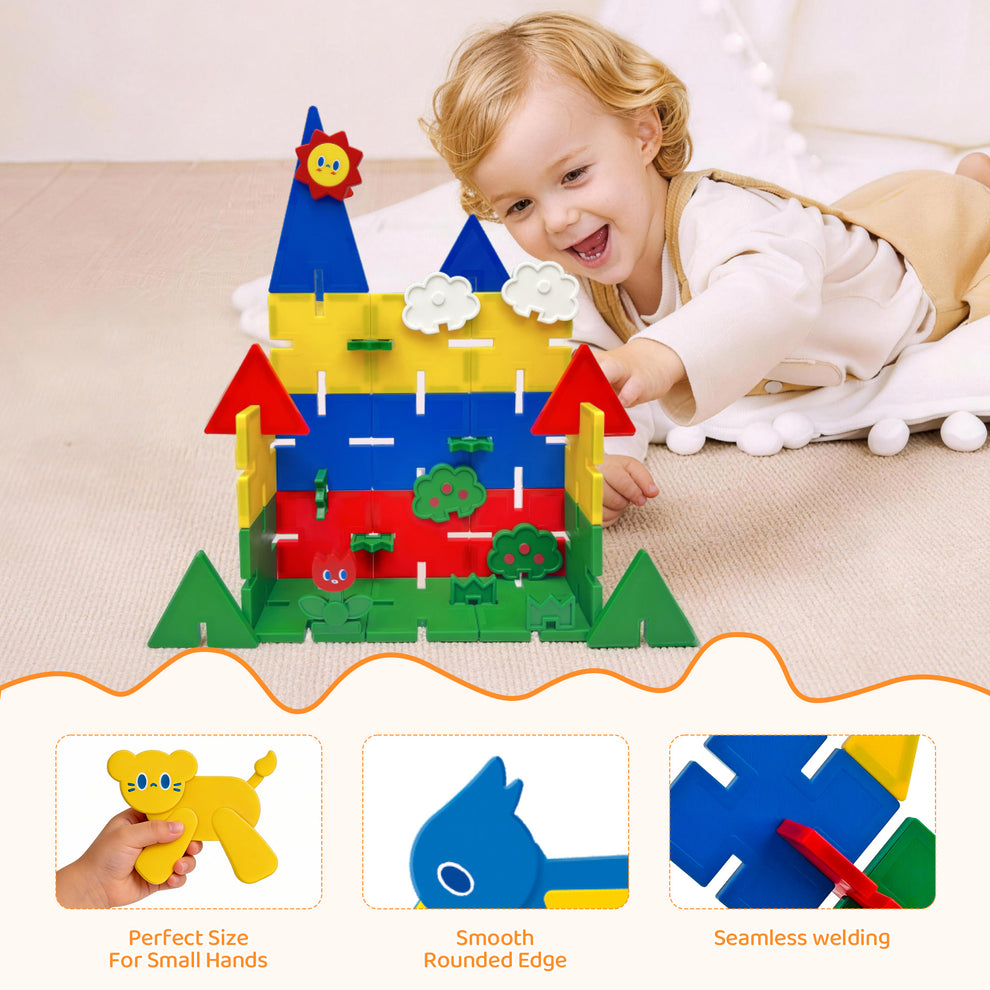
Use compatible edge or slot connections wherever they suit the next arrangement. The lion and bird are documented scene pieces, so they can help shape the story when compatible connection allows, or they can simply be positioned nearby as part of the scene. Avoid assuming every theme piece connects in every orientation.
If you are running low on squares or triangles, shorten the creature body. The remaining pieces can become feet, a tail, a nest, a hill, or a very fancy snack stop. A smaller build can still have a large plot.
MagFlake magnetic tile static windmill model
A MagFlake magnetic tile static windmill model can begin as a low building-like form rather than a complicated project. Make a square base or flat body. Add triangles to suggest a roof or blade-like silhouette. Keep it static. The goal is a windmill-style scene, not a moving mechanism.
Once the main shape is done, bring in the story pieces. Grass or turf pieces, flowers, clouds, shrub or tree-like pieces, and the sun face can turn the table into a field. Add them where compatible connection allows, or position them around the structure as scenery. A static windmill scene may become a bird lookout, a lion's garden, or a moonlit tower five minutes later. That is not a derailment. That is the plot improving itself.
MagFlake magnetic tile edge vs interlocking slot: Adjust the wonky parts
Every family build reaches a moment when the roof develops opinions. It may tilt. A connection may point in an unhelpful direction. The pieces left in the pile may not match the grand plan that existed three minutes ago.
That is normal play. Try a small adjustment before starting over completely.
| What you notice | A practical next move | A helpful way to frame it |
|---|---|---|
| The build leans | Remove the highest piece and simplify the bottom arrangement | "Let's see what this version wants to be." |
| A connection points the wrong way | Separate the pieces, rotate one, and try another angle or pair | "The first try gave us information." |
| The roof looks crowded | Remove one triangle or change its placement | "Maybe it is a tower now." |
| Pieces are running low | Keep a favorite section and turn remaining pieces into scenery | "A smaller build can have a bigger story." |
| Siblings want different things | Give each child a zone, such as main build and garden or sky | "One scene can have two plot twists." |
When a connection does not sit as expected, switch methods only if it helps the new plan. A magnetic edge may be a quick way to test a new triangle placement. A compatible slot arrangement may offer a different direction with slotted building pieces. If neither route suits the shape, make the build flatter, lower, or smaller.
This is especially useful in a short after-school window. You do not need to rescue every leaning tower before dinner. Sometimes the best ending is, "That is our bird cave now," followed by a peaceful move toward cleanup.
MagFlake magnetic tile edge vs interlocking slot: Reset the table for tomorrow
A reset can be part of the game, not the part after the game. When time is short, skip the perfect sorting system and make three loose groups:
- Square building pieces.
- Shorter and longer triangular pieces.
- Theme and scene pieces, such as grass or turf, flowers, clouds, the lion, the bird, and sky-themed pieces.
Sort MagFlake magnetic tiles colors shapes theme pieces
The phrase sort MagFlake magnetic tiles colors shapes theme pieces can sound like a very official assignment, but it works best as a simple choice. Ask, "Would you rather collect triangles or garden pieces?" One child can gather basic shapes while another gathers scene pieces. If someone prefers sorting by favorite colors or pointy pieces instead, that rule is perfectly fine for today.
Keep one small "tomorrow idea" cluster aside if the family wants to remember a build. Everything else can return to the main storage container. This gives an unfinished story a sequel without leaving the entire sofa route occupied by tiles.
For the next build-and-redesign session, explore the MagFlake 2 in 1 Magnetic Tiles 58-Piece Set. Start with an edge, try a compatible slot when the build asks for another route, and let the unexpected version count as the real one.
Ages 3+; follow the current product label and instructions.
Comments
No comments yet. Be the first!