

How Many Magnetic Tiles Does a Small Classroom Group Need?
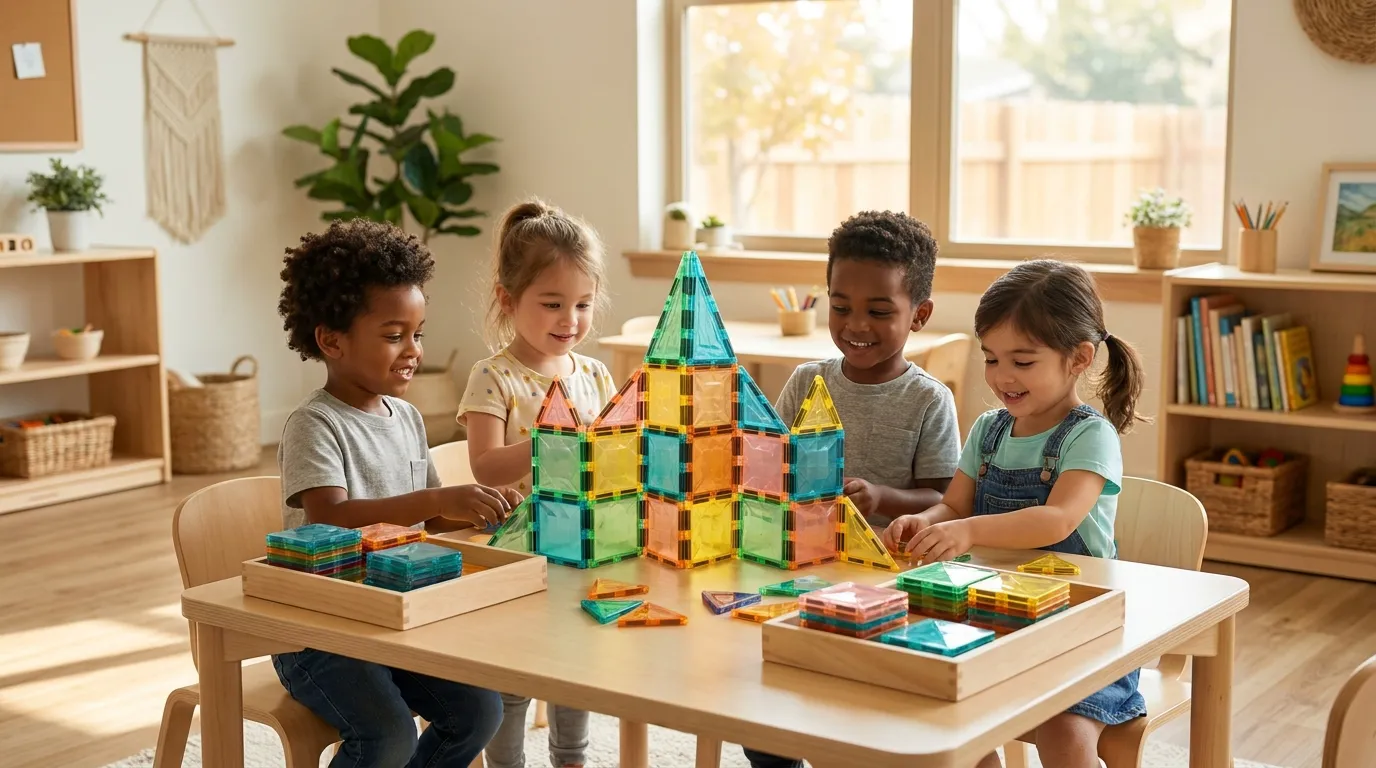
Have you ever wondered if a small group might run out of magnetic tiles before they get into their building?
The answer depends less on how many children are playing and more on what they are building: two children working together on a single small bridge will use a compact set very differently than four children each trying to start their own separate house. When you're thinking about magnetic tile set planning for group play, it helps to consider a few things: how many children are building at the same time, what kind of activity they're doing, how much space you have, and how you'll manage cleanup.
There isn't a strict rule for how many magnetic tiles you need per child. Instead of thinking of a set as a fixed amount for a certain number of builders, we can look at some ideas to help match the materials to your own playroom or classroom setup.
Start with the Activity Format
Before you even pick out a set, here’s a simple question to ask yourself: Are the children going to be creating one shared project together, or will they each be working on their own separate creations?
If they're building a shared project, the available pieces can go a long way. Imagine three children collaborating on one neighborhood, a connected bridge system, or an animal habitat, with each child focusing on a section. A smaller set can support this kind of teamwork, especially when you give them a clear starting idea and everyone understands that the tiles are for the group to share.
On the other hand, if everyone is building separately, tiles tend to disappear more quickly. If each child wants their own tower, house, or vehicle, they'll need lots of pieces for multiple bases, walls, and roofs. In that case, having a larger common collection of tiles usually makes things smoother than trying to divide every single piece equally among them.
Also, it’s helpful to think about the type of activity:
- Structured challenges often work well with a smaller supply because the task has a clear beginning and end.
- Open-ended building benefits from having more pieces, as children might rebuild, expand on their ideas, and combine different concepts.
- Short rotations are best with simple prompts and quick, easy resets.
- Longer play periods can support bigger shared projects, especially if you plan for their creations to stay displayed for a while.
It’s also good to set up construction areas away from busy pathways. Make sure there’s enough room for children to reach the tiles comfortably without having to step over someone's elaborate build. The Illinois Early Learning Project also suggests having a protected building space, keeping materials organized, and allowing children the freedom to build and rebuild.
Use 32 Pieces for Focused Activities
A 32-piece set can be a handy, compact building resource. The YRZtiles 32pcs STEM Magnetic Tiles and Building Blocks set can be a sensible choice for one child, a specific tabletop invitation, or for a pair working on one defined task together.
When considering a magnetic tile set for two children, 32 pieces can work well if they’re both focused on a single goal. However, it might feel a bit limited if both children want to create separate, detailed 3D structures at the same time.
Here are some helpful 32-piece building ideas that keep the scope manageable:
- Create a flat, symmetrical picture together.
- Build one small shelter or house as a team.
- Construct a tower, then take it apart, and try a new design.
- Arrange tiles to make a repeating color pattern.
- Take turns adding just one tile to a shared creation.
- Design a compact rocket, an animal shape, or a vehicle-inspired form.
Small-Set Classroom Challenges
A thoughtful prompt from a teacher or caregiver can make a smaller set feel purposeful and engaging rather than restrictive. You might try challenges that encourage planning, testing, and making adjustments, rather than expecting a huge inventory of specialty shapes.
| Challenge | Why it suits a compact set |
|---|---|
| Build a freestanding tower | Children can experiment with stability and redesign without needing a large area. |
| Make a flat picture using three colors | The activity stays neatly within a tray or on a table. |
| Create one shelter from a story prompt | Partners can contribute to a single shared outcome. |
| Build a repeating pattern twice | The focus is on the arrangement and design, not just having a lot of pieces. |
| Add one feature after switching places | This encourages working together and can help prevent disagreements over who "owns" what. |
It's a good idea to avoid challenge cards that require exact quantities of specific shapes unless you've already checked your own set to make sure you have them.
Compare 32, 100, and 106 Pieces
The difference between having 32 pieces and 100 pieces isn't just about "small" versus "better." It's more about how much freedom children have to build, revise, and expand their creations.
| Planning question | 32-piece set | 100-piece set | 106-piece set |
|---|---|---|---|
| Best practical use | Individual play, a prompt for a pair, compact building | Shared small-group projects and rotating activity centers | Longer shared construction projects and prompts for detailed building |
| Workspace needs | A small table or tray | A larger table or a dedicated space on the floor | A larger table or a dedicated space on the floor |
| Parallel builds | Can quickly feel too confining | Offers more flexibility for shared resources | Offers more flexibility for shared resources |
| Cleanup load | Quicker to gather and check | Needs a clear routine for putting things away | Needs a clear routine for putting things away |
The idea of 32 vs. 100 piece magnetic tiles space is something to genuinely consider. A 100-piece set opens up more building possibilities, but it also means you’ll need a larger clear workspace, especially if children start building outwards in several directions. A cluttered table can make even a big set feel frustrating to use.
For a 32 vs. 106 piece magnetic tile set comparison, the most noticeable difference is simply the total number of pieces: 32 versus 106. The YRZtiles 106pcs STEM Magnetic Tiles and Building Blocks set is a stronger starting point when a group plans a more extended shared build or wants to explore architecture and vehicle-inspired ideas. It’s helpful to remember that this isn't a guarantee for a specific number of children, but rather offers more potential for grander projects.
When you're thinking about 100 piece classic magnetic tiles vs. MagFlake magnetic tiles 58, it’s best to start by noting the clear difference in piece count and the type of set. The YRZtiles 100pcs STEM Magnetic Tiles and Building Blocks product is a 100-piece Classic set, while the MagFlake - 2 in 1 Magnetic Tiles 58Pcs Set is a distinct 58-piece, 2-in-1 option. It's good to think of MagFlake as a different kind of activity altogether, rather than assuming it's the same as a Classic set.
Organize a 100-Piece Group Activity
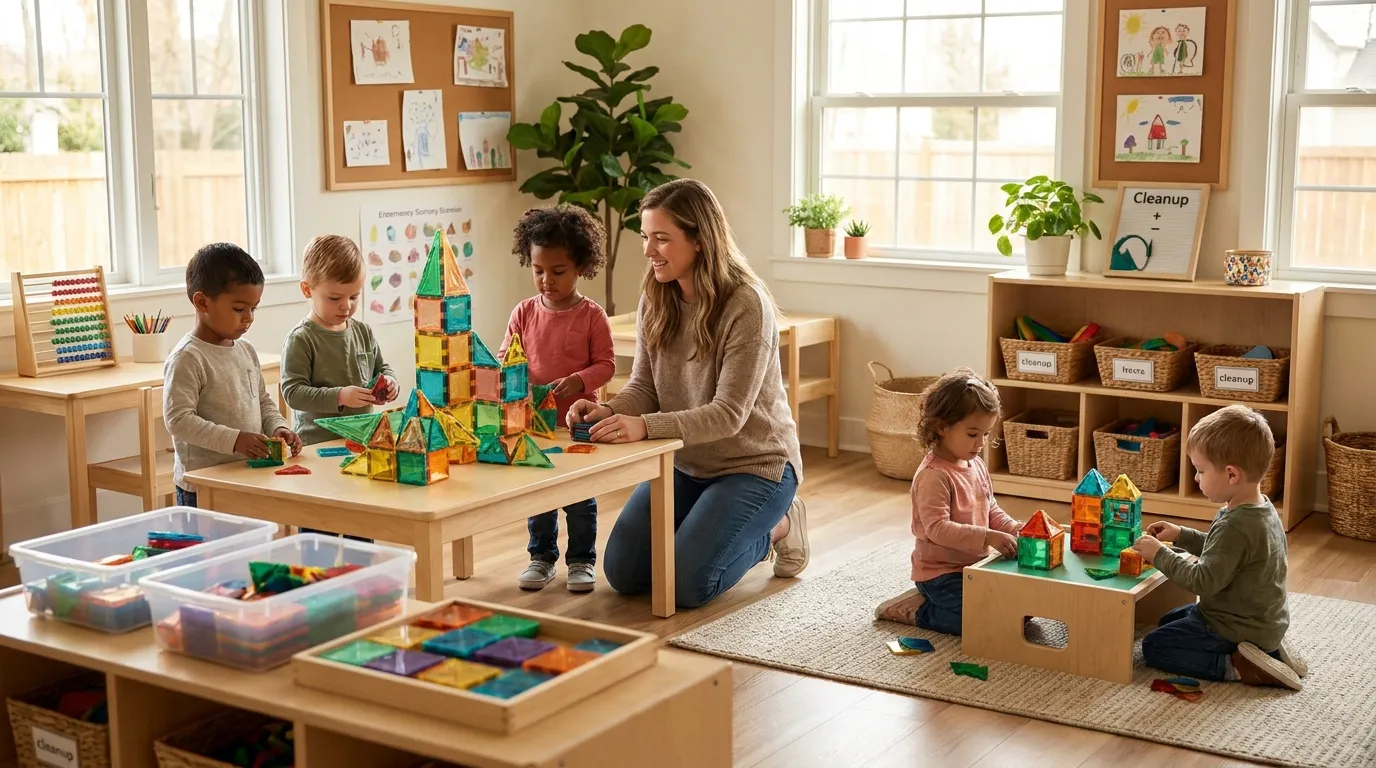
If you need to divide 100 magnetic tiles for group play, giving everyone an equal number of pieces isn't always the most helpful approach. Often, distributing access and defining roles works better than trying to make sure every child has identical pieces.
Here are some practical ways to manage this:
- One shared bin: Put all the tiles in the middle for one connected group project. This works well for building a town, a bridge system, or a large shelter together.
- Two pair trays plus an expansion tray: You could start two pairs of children with roughly similar materials, then let both groups draw from a shared supply as they need more.
- Building roles: Encourage one pair to start the base, another to add walls or interesting features, and yet another to create a surrounding scene.
- One group at a time: If you're doing rotations, keep the full set at one center and ask children to reset it neatly before the next group comes in.
To plan large builds with 100 magnetic tiles, it helps to define the building boundary before children begin. A rug, a floor mat, or a large table can clearly show where the project belongs and help prevent accidental bumps. Start with one collaborative idea, like "Let's build a connected neighborhood," rather than giving everyone separate prompts.
Pause partway through and ask, "Are we still making one shared structure?" If the group has started building separate things, you can either gently redirect them to the original goal or offer another rotation later. This simple check helps make sure materials are available for the group's purpose.
Build Cleanup and Storage into the Plan
Magnetic tiles work well in a playroom or classroom when children and adults can put them away consistently. Larger sets offer more flexibility during play, but they also mean there are more pieces to gather, check, and return to their spot.
You can establish a consistent cleanup routine:
- Give a brief heads-up before play time ends.
- Decide together if a shared structure will stay displayed or if it needs to be taken apart.
- Ask children to collect all the loose pieces into one designated tray or bin.
- Assign quick roles, like "floor checker," "gatherer," and "bin returner."
- If it's practical, count the set, especially after a group activity, to make sure everything is there.
- Take out any damaged pieces and follow the product label and age guidance.
Clearly labeled, easily accessible storage makes for a much smoother reset. A picture or a simple visual card on the bin can help children see what belongs in that spot without needing a system to sort every single shape.
Magnetic products do require careful supervision and keeping track of the pieces. The U.S. Consumer Product Safety Commission magnet-safety guidance reminds us of the serious risks if powerful magnets are swallowed. Always follow age labels, inspect the materials regularly, and act quickly according to your safety procedures if you suspect ingestion.
Choose a Set by Classroom Scenario
You can use this quick guide as a starting point; it's not a strict rule or a guarantee.
| Classroom scenario | Practical YRZtiles starting point | Planning note |
|---|---|---|
| One child building independently | YRZtiles 32pcs STEM Magnetic Tiles and Building Blocks | This size works well for focused builds, creating patterns, and shorter activities. |
| Two children sharing one project | 32-piece set or YRZtiles 100pcs STEM Magnetic Tiles and Building Blocks | Choose 32 pieces for a contained shared task, and 100 pieces if you want more independent choices for them. |
| A station for pairs with repeated daily rotations | YRZtiles 100pcs STEM Magnetic Tiles and Building Blocks | A larger collection means each new pair has more room to build and refine their ideas. |
| Three or four children building one structure | 100-piece Classic set | This works best when they have one shared goal and a defined area to build in. |
| A group project for detailed architecture or vehicle designs | YRZtiles 106pcs STEM Magnetic Tiles and Building Blocks | Keep the larger number of pieces in mind and make sure you have enough floor or table space. |
| A smaller activity with a mix of formats | MagFlake - 2 in 1 Magnetic Tiles 58Pcs Set | Remember this is a distinct format, not a direct substitute for Classic tiles. |
The best magnetic tile set is the one that fits the activity you can thoughtfully supervise, store, and help reset. For effective magnetic tile set planning for group play, consider how many children will be building at once, whether they are working together or separately, how the workspace stays protected, and whether there is enough time for cleanup.