

Choosing a Magnetic Tile Set for Two Children to Share
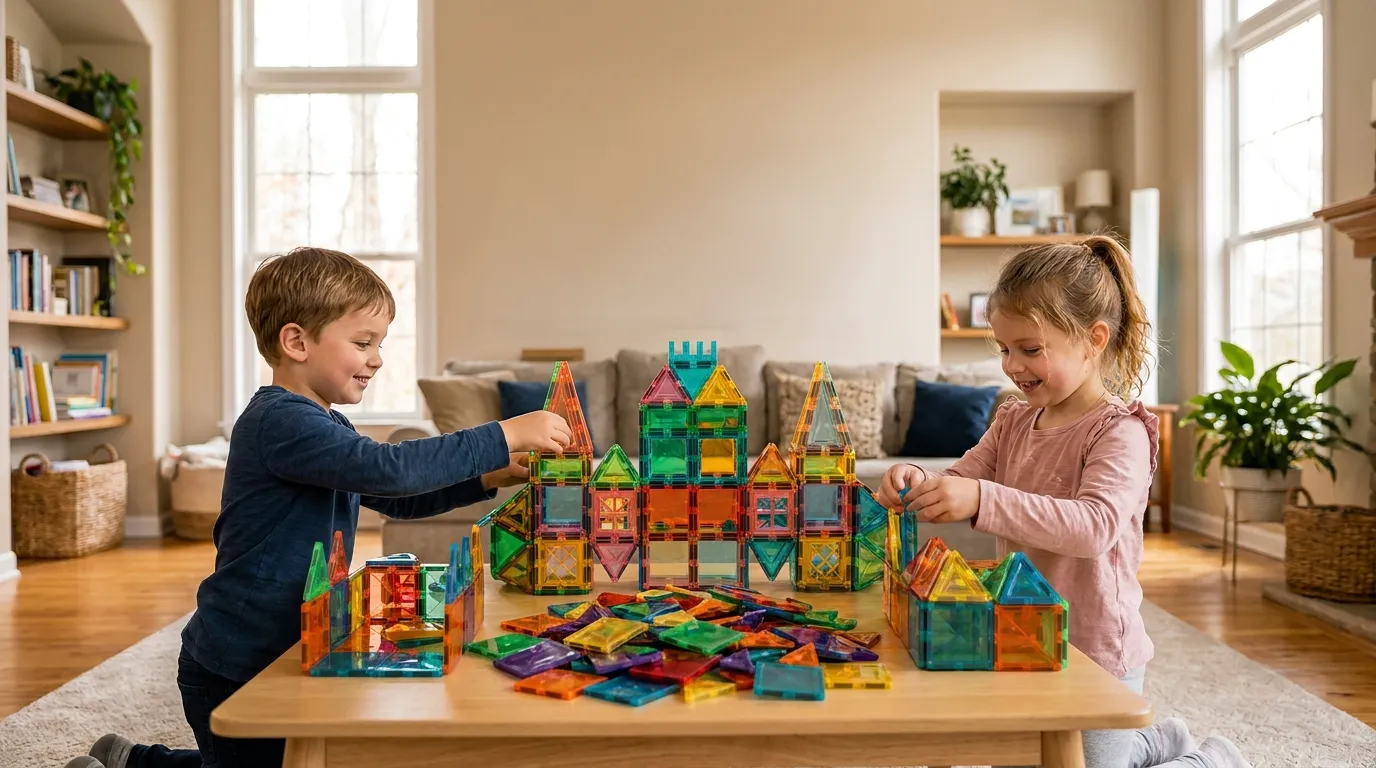
Do your two children reach for the same magnetic tile at the exact same moment?
Choosing a magnetic tile set for siblings is not about a fixed number of pieces for each child. It is more about noticing how they play. Some children are happy with parallel play, building their own creations right next to each other. Others love combining every single piece into one grand castle, a bustling town, a vehicle, or an imaginary world. Available space, cleanup habits, and likely playdates matter just as much as the number on the box.
Start with the Way Your Children Play
Before we even start comparing sets, let’s take a moment to watch a couple of typical play sessions. Do your children build quietly, side by side? Do they work together to create one big shared design? Or does one child quickly make a flat picture while the other prefers to save a detailed structure for later?
This difference matters. In parallel play, children build next to each other without necessarily having the same goal. Cooperative play, on the other hand, centers around a shared purpose. It is normal for siblings to switch between these two styles of play during one session.
Side-by-side builds need flexible access
If you have parallel builders, try not to automatically split the pieces right down the middle. A child building a wide, low house might need more pieces than another who’s putting together a small vehicle. Instead, what works well is creating two separate building zones. Then, have a small central "pool" of pieces that both children can easily reach and use.
This setup is especially helpful for a magnetic tile set for two children. It gives each builder a sense of ownership over their space without every single piece turning into a negotiation. A kitchen table can work well for smaller, compact projects, but a rug or a play mat offers more room for those times when their plans expand.
Shared projects need a simple agreement
When your children decide they want to make one big creation together, it helps to start with a little plan. Something like, "Let’s make a town with one house, one road, and one vehicle." Then, each child can take responsibility for a part of the project. One might build the base, while the other adds the roof, an entrance, or a neighboring structure.
For all the current options, you can view current Classic magnetic tile sets and see if the piece count matches the usual size of your family’s projects.
When 32 Pieces Can Work
A 32-piece set acts like a compact shared pool of materials. It can be just right for quick after-school sessions, when you’re playing on a small table, for families who clean up often, and for projects that have clear boundaries. It’s usually not the best choice if both children expect to build large, separate 3D designs at the same time.
The YRZtiles 32pcs STEM Magnetic Tiles and Building Blocks set is the smallest current Classic option. Think of it as a solid starting point for focused activities and shorter builds, rather than expecting two identical, sprawling projects.
Shared Building Ideas for 32 Pieces
Let’s try some goals that make the limited number of pieces part of the fun:
- Build two different flat pictures without taking any pieces apart.
- Make a tower with a wide base, but keep it a limited height.
- Each child can create a mini-build, then connect their creations with just one jointly chosen piece.
- Take turns adding one tile at a time to a shared structure.
- Build a scene, describe what’s happening in it, and then carefully return every piece to the tray.
These 32-piece building ideas keep two children engaged without a strict division of pieces. They also make cleanup a bit smoother because the project naturally comes to an end.
Compact Two-Child Challenges
Short challenges can help reduce any competition for specific pieces. Some good magnetic tile challenges with 32 pieces include a "build and swap" activity. In this, each child makes a small object, and then the other child adds one new piece without removing the original design. Another option is a ten-piece tower challenge, where children explore different base shapes before adding height.
For families who use a small table or clean up after every playtime, 32 pieces can be plenty when the activity is contained and collaborative.
When 100 Pieces Make Sharing Easier
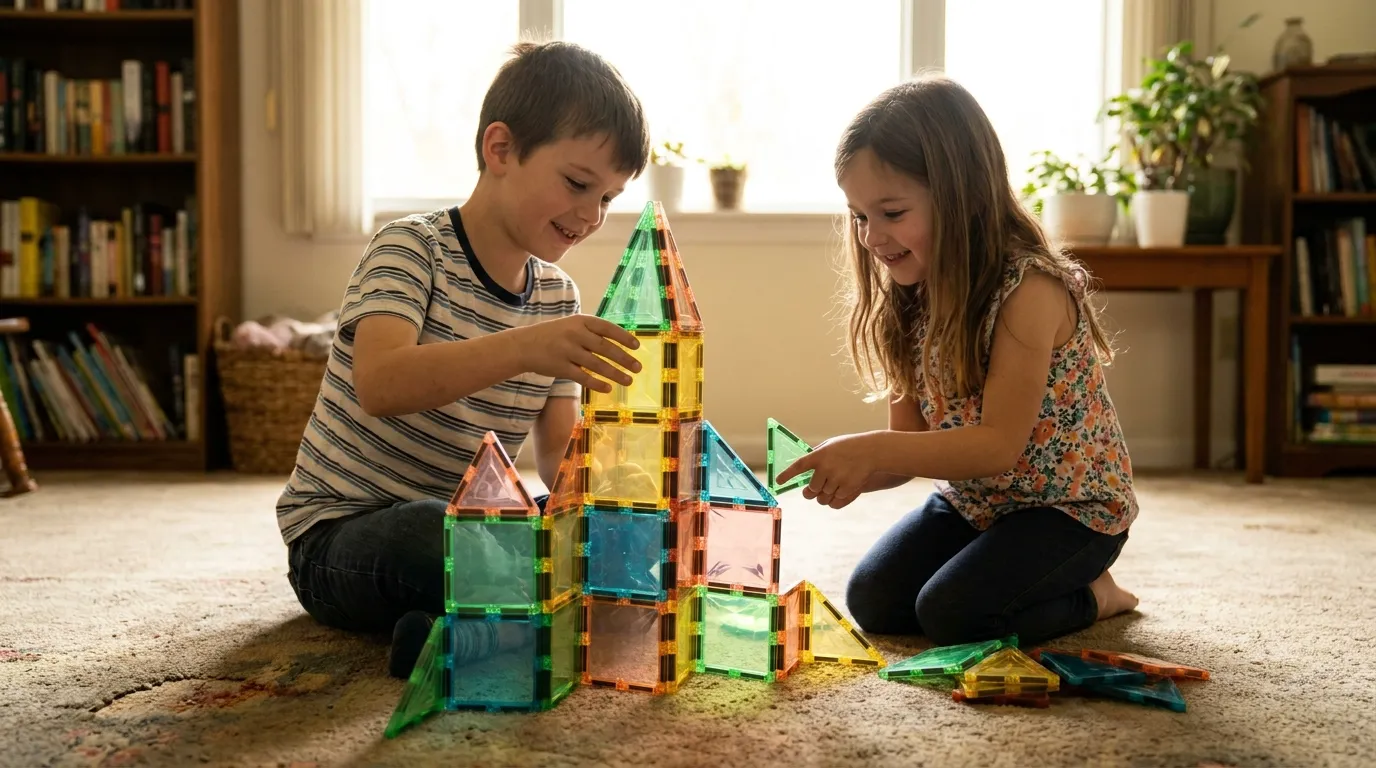
A larger pool of pieces tends to make sharing feel more relaxed. This is especially true when two children are building independently, revising their designs, or merging separate creations into a bigger scene. The YRZtiles 100pcs STEM Magnetic Tiles and Building Blocks set is often a practical choice for siblings who regularly come back to the tiles to build towns, multi-part structures, and simply enjoy open-ended play.
The benefit here isn’t about a fixed formula of pieces per child. Instead, the larger total allows children to keep more of their current work intact while still having plenty of loose tiles available for changes or additions.
Share 100 Pieces Without Keeping Score
To divide 100 magnetic tiles for group play, you could try a three-part setup:
- Give each child their own clearly defined personal building area.
- Place a community pile or a shallow tray of tiles between them.
- Encourage children to borrow from the shared pile before asking for a piece from another child's completed build.
This routine is often more helpful than insisting on perfectly equal piles. It supports different ideas and makes it easy to ask for a desired piece in a friendly way: "May I use that once your roof is finished?"
Build Larger Projects in Phases
To plan large builds with 100 magnetic tiles, it helps to keep the project manageable by building it in stages. First, agree on a small central point, like a building, an enclosure, a road, or a vehicle. Next, each child can add their own section or module. Finally, connect all the modules once both builders are ready.
This approach also helps preserve a project that might need to be taken apart later. You can snap a photo before cleanup, then sort and count the pieces together. For more sharing approaches, the YRZtiles news hub offers guidance on group play and magnetic tile challenges.
On space, the difference between 32 and 100 pieces is not only about how much storage volume they take up. A 32-piece set naturally encourages compact projects. A 100-piece set gives children more room to leave one structure standing while they experiment with another. That usually means you'll need a larger tabletop, a designated rug area, or a special project tray.
Choose Between the 100-Piece and 106-Piece Sets
The decision between the 100-piece and 106-piece Classic sets shouldn’t come down to those six extra pieces alone. Both sets offer a significantly larger shared pool than the 32-piece option. The better choice comes from thinking about the kinds of projects your children tend to build again and again.
| Comparison point | 100PCS Classic | 106PCS Classic |
|---|---|---|
| Best suited to | Broad shared construction and parallel builds | Detailed architecture and vehicle-oriented scenes |
| Shared-play advantage | More loose material for additions and revisions | Similar larger pool with architecture-focused options |
| Planning approach | Build zones plus a central shared tray | Shared scene with assigned building roles |
| Important note | Do not assume an exact shape inventory from the total count | Check the live page for current contents before purchasing |
The YRZtiles 106pcs STEM Magnetic Tiles and Building Blocks set is particularly worth considering if your children love building houses, gates, castles, and playing with vehicles. Its specialized, architecture-oriented building options and the single wheeled chassis might be more important to your children than just the difference of six pieces.
For a 32 vs 106 piece magnetic tile set comparison, the same idea applies: the smaller set is great for compact challenges, while the larger set is much better for sustained building, more options happening at the same time, and broader floor layouts.
When we talk about 100 piece classic magnetic tiles vs MagFlake magnetic tiles 58, we’re looking at two different types of play decisions. Classic sets are often the clearer choice when you need a larger general pool for construction. The MagFlake 58-piece set is most relevant if your two children are especially keen on storytelling scenes, perhaps involving gardens, animals, weather, or characters. Because MagFlake includes insert cards and decorative accessories along with the magnetic construction, it’s best to think of it as its own unique play style rather than a direct substitute for a larger Classic set.
Plan for Storage and Safe Use
Storage is part of the decision. More pieces can inspire bigger ideas, but they also mean we need a clearer routine for putting them away. Using a shallow bin or tray during play keeps loose tiles visible. You can also set a simple boundary around the active building area. A placemat, a tray, or a section of rug can help children see where their project is allowed to grow.
For projects that are still underway, it’s good to decide in advance if the build can stay out. If not, a quick photo can help children feel okay about taking it apart. During cleanup, you can even make counting part of the game: one child gathers the tiles while the other checks them as they go into the bin.
Magnetic tile play also needs our careful supervision and inspection. Always follow the age label, keep tiles away from younger children and pets, and stop using any tile that has a cracked shell, a separated seam, an exposed magnet, or a missing magnet. The U.S. Consumer Product Safety Commission's magnet safety guidance warns that swallowed or inhaled magnets can cause serious injury. If you suspect magnet ingestion, please seek immediate medical attention.
A Quick Match by Family Routine
| Your family scenario | Best YRZtiles starting point | Helpful routine |
|---|---|---|
| Short sessions and small table | 32PCS Classic | Use small challenges and a single cleanup tray |
| Two independent builders | 100PCS Classic | Set up two zones with a shared-parts area |
| One evolving house, town, or large scene | 100PCS Classic | Build in modules, then connect them together |
| Architecture and vehicle-focused shared stories | 106PCS Classic | Assign flexible roles and confirm current specialty contents |
| Occasional friends or cousins joining | 100PCS or 106PCS Classic | Shift toward a communal scene or short timed turns |
The right choice for a magnetic tile set for two children is the one that fits your family's daily routines. Pick 32 pieces for compact, guided play. Choose 100 pieces when two builders want more freedom to create at the same time. Consider 106 pieces when detailed buildings or vehicle-centered scenes are likely to keep both children happily engaged.