

What Can Kids Build with a 32-Piece Magnetic Tile Set?
A compact set can still lead to satisfying play. With YRZtiles 32pcs STEM Magnetic Tiles and Building Blocks, children Ages 3+ can create colorful flat pictures, small geometric forms, low towers, simple houses, short bridges, and imaginative mini-scenes.
The important expectation is scale. Thirty-two pieces are enough for one focused idea at a time, not a sprawling castle, a multi-room town, or two separate large 3D projects happening at once. For families considering planning a shared activity with magnetic tiles, the best first decision is simple: will children build one project together, or do they each want their own build?
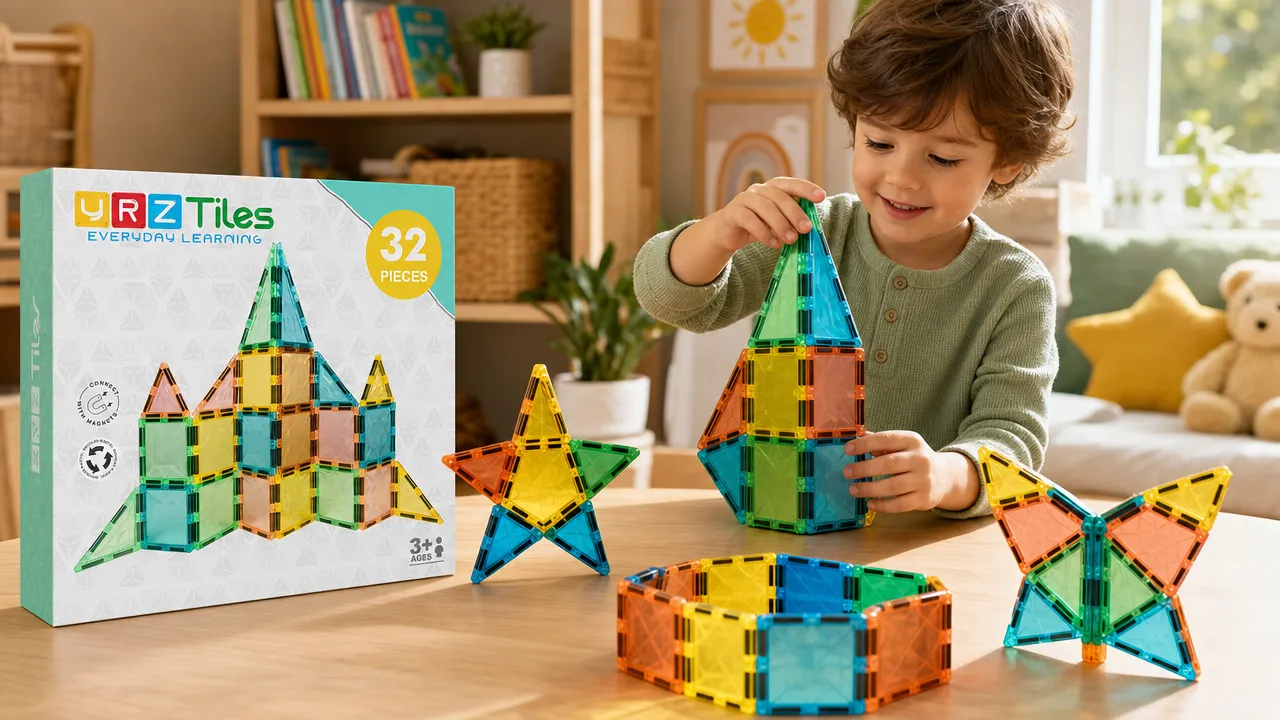
What can children build with 32 pieces?
The most useful ideas for a 32-piece set are compact, repeatable, and flexible. Because YRZtiles confirms the total piece count but does not publish a reliable shape-by-shape inventory for this set, it is best to work with the pieces your child has available rather than following a recipe that requires a fixed number of squares or triangles.
A 32-piece Classic set can support:
- Flat mosaics, color patterns, and symmetrical pictures.
- A flower, starburst, face, animal, rocket, or road-map interpretation.
- A small open or enclosed geometric form.
- A one-room house, animal pen, pretend garage, or tiny space station.
- A low tower with a wide base.
- A short bridge or two-support structure.
- A build, test, and revise challenge.
It is less practical for a large castle with several towers, an entire neighborhood, or a long-lasting sibling project where both children want to independently build tall structures. That does not make a smaller set limiting in a negative way. It simply gives play a clearer focus: make one idea, save a few pieces for changes, then rebuild it differently.
Start with flat pictures and patterns
A small collection often feels more useful when children begin in two dimensions. Flat patterns create a finished-looking result with fewer pieces, and they leave extra tiles available for revisions.
Start by spreading out the tiles and asking a simple question: "What picture can you make with these colors and shapes?" A child might make mirrored butterfly wings, a color stripe, a flower-like design, or a pretend road. If perfect symmetry is not possible, "almost matching" sides can become part of the creative challenge.
Next, connect a small flat arrangement and gradually lift one edge. This flat-to-standing approach gives children an opportunity to notice how connected edges change the shape. Encourage them to build broad before building tall. If a low tower falls, that is a reason to change the base or angle, not a reason to add more height immediately.
For a compact house or pen, use the available pieces to make a low outline, raise a few sides, and treat any open space as an imagined entrance. Do not assume the 32-piece Classic set includes doors, windows, wheels, or specialty accessories.
Optional materials, not included, can extend the story without demanding more tiles. A paper sign, cardboard road, toy figure, or small non-magnetic vehicle can help turn one compact structure into a larger pretend-play scene.
Make a small shared scene
Planning shared play with magnetic tiles works best when the project has a shared purpose. With 32 pieces, children are more likely to enjoy the experience when they cooperate on one small scene instead of competing for pieces for two separate large builds.
One child and a compact set
For one child, try a short planning routine:
- Choose one prompt, such as a picture, bridge, house, or tower.
- Set aside a small change pile for later revisions.
- Build a first version.
- Change just one feature, such as the roof, base, color pattern, or entrance.
- Count and inspect the pieces during cleanup.
This approach can offer opportunities to explore shapes, describe choices, and revise an idea without suggesting that every play session must become a major project.
Two children, one compact set
A a set shared by two children can work well when siblings agree on a compact shared goal. Try one of these low-conflict formats:
- Architect and builder: One child describes the next addition while the other places a piece. Then they swap roles.
- One-piece-each build: Children alternate adding a single tile to one shared structure.
- Build and swap: Each child makes a tiny four-to-six-piece object, swaps it, and adds one piece without dismantling the original design.
- Scene partners: One child creates a small house or enclosure while the other makes the path, roof idea, or surrounding flat pattern.
An even split may sound fair, but it is not always practical because different shapes may not be available in equal quantities. If siblings frequently want separate, substantial 3D builds, more pieces can reduce waiting and negotiation.
Here are five simple challenges for a 32-piece set:
- Build a freestanding tower with no more than 10 pieces.
- Make a flat design using only one available shape type.
- Create a two-color repeating pattern.
- Test two roof angles on the same small house, if triangles are available.
- Make a short bridge using two supports and one connected deck piece.
When a larger set can help a group
When families want to share a 100-piece set among several builders, a shared supply is usually more flexible than assigning permanent ownership of every piece. The YRZtiles 100pcs STEM Magnetic Tiles and Building Blocks set has 68 more pieces than a 32-piece set, giving groups more room for parallel ideas, connected sections, and revisions.
For four children, try this editorial planning example:
| Group area | Working budget | Suggested job |
|---|---|---|
| Structure zone | 25 pieces | Build one main low structure |
| Pattern or road zone | 25 pieces | Create a flat route or repeating design |
| Roof or landscape zone | 25 pieces | Add roofs, borders, or scene details |
| Shared revision pool | 25 pieces | Borrow for changes and final connections |
This is not an official product instruction. It is a simple way to prevent one builder from using every available tile at the beginning of play.
To plan a larger shared build, give each child a role instead of assigning specific shapes. One child can design the main structure, another can build a flat pattern or path, and another can help connect sections. Leave one open edge on each part so the group can join them at the end.
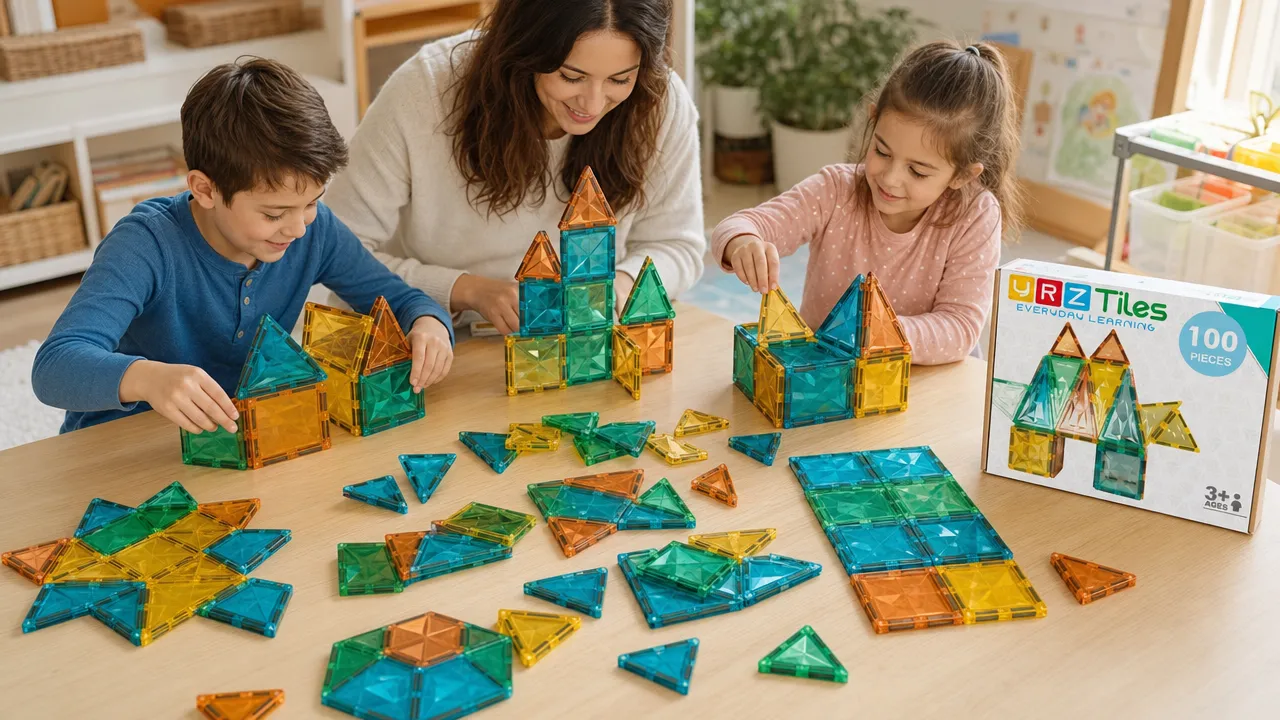
How the Classic set sizes differ
The difference between 32 and 100 pieces is mainly about how many ideas can happen at once, not about storage space. A 100-piece set gives builders more tiles for a wider flat layout, additional walls, multiple sections, and changes made during construction.
| Set | Best fit | Important boundary |
|---|---|---|
| 32-piece Classic set | One child, flat pictures, low builds, and short shared challenges | Do not assume an exact shape inventory or specialty accessories |
| 100-piece Classic set | Shared towns, larger patterns, and more room for siblings to build | Do not assume wheels, doors, windows, or storage details |
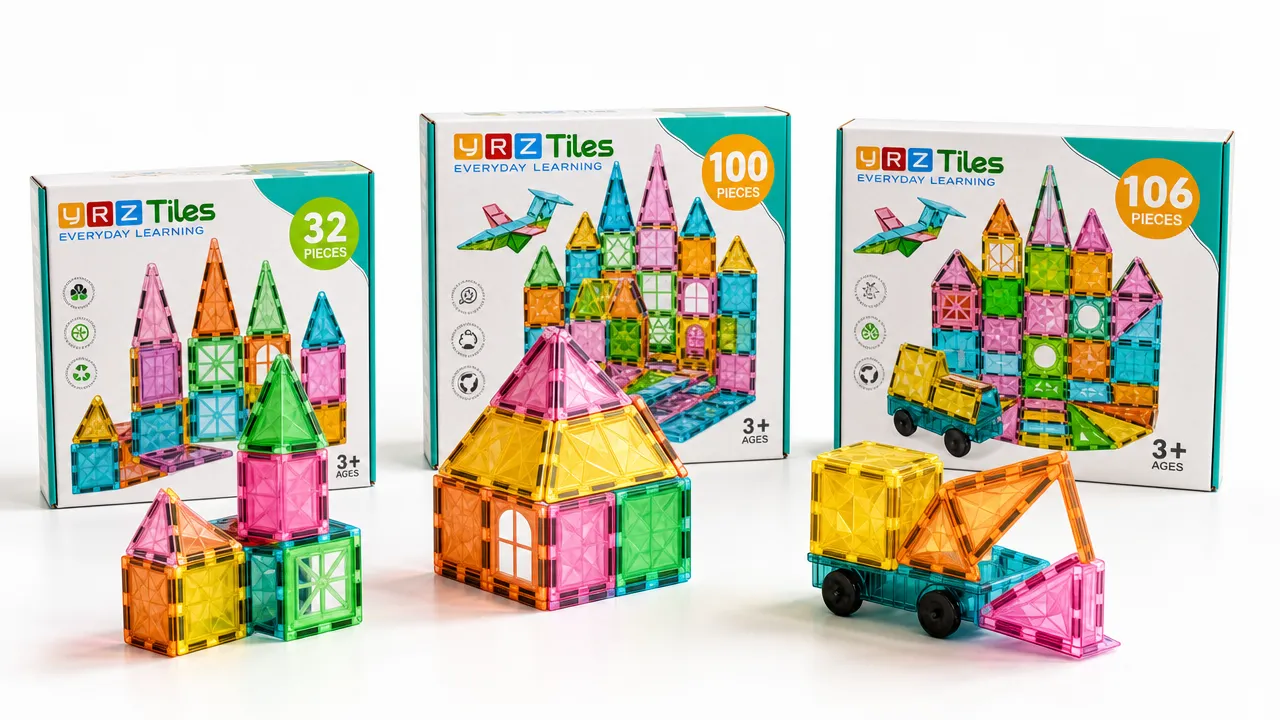
| 106-piece Classic set | More detailed architecture and vehicle-style prompts | Official imagery documents architecture-oriented pieces and one wheeled chassis for this set |
| 58-piece MagFlake hybrid set | Families interested in a separate hybrid magnetic-edge and interlocking-slot format | Do not treat MagFlake as a 58-piece version of the Classic system |
When choosing between the 32-piece and 106-piece Classic sets, the difference is more than the additional quantity. The 106-piece Classic set has documented architecture-focused pieces and one wheeled chassis, so it is the appropriate choice to consider for prompts centered on detailed houses, gates, windows, or vehicle redesigns.
The 100-piece Classic set and 58-piece MagFlake set should also be treated as different systems. MagFlake is a separate hybrid system with magnetic edges and interlocking slots. Families should choose it for that specific format, not assume that its features, decorative pieces, or building behavior transfer to Classic magnetic tile sets.
Safety and cleanup
Magnetic tile sets are for Ages 3+ according to current product material. Inspect pieces before play. Stop using cracked or separated pieces, or any piece with an exposed or missing magnet. Keep magnet-containing pieces away from younger children. Seek immediate medical attention if magnet ingestion is suspected. The U.S. Consumer Product Safety Commission magnet safety guidance explains why suspected magnet ingestion needs immediate care.
A 32-piece set is a practical choice for compact, creative builds when expectations match the piece count. For larger sibling projects, classrooms, or connected towns, 100 or 106 Classic pieces provide more planning room. Thoughtful planning a shared activity with magnetic tiles is less about chasing the biggest creation and more about matching the number of pieces to the number of builders and the kind of play they enjoy. For more options, explore Classic magnetic tile sets.