

Inside the YRZtiles 106-Piece Magnetic Tile Set: Shapes, Windows, Doors, and Chassis
If you are comparing sets or replacing a missing piece, this documented inventory gives you the complete starting point. This is a Classic magnetic tile set with a broad mix of core geometry, architecture-oriented pieces, and one wheeled chassis for child-led construction and storytelling.
The official product listing identifies it as the YRZtiles 106pcs STEM Magnetic Tiles and Building Blocks. Its 106 pieces include squares, three triangle categories, rectangles, windows, double-door panels, frame pieces, small specialty pieces, and one wheeled chassis.
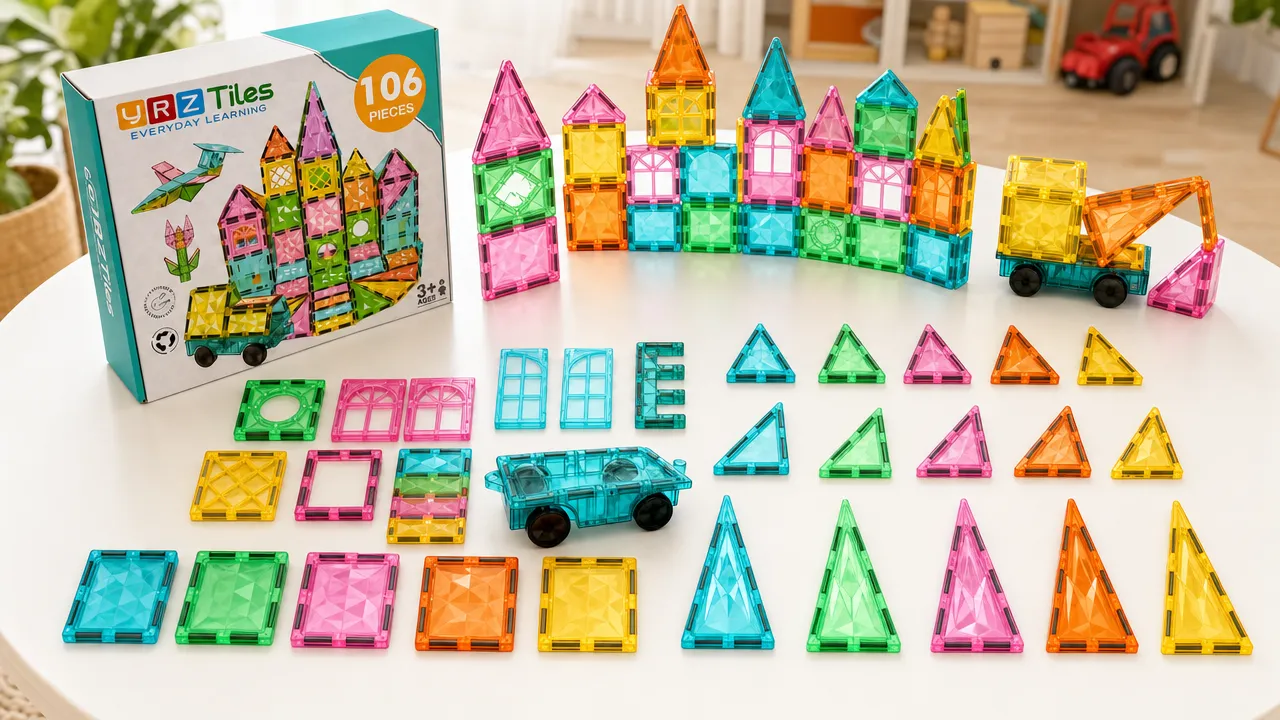
Documented inventory for the 106-piece Classic set
Here is the fixed, documented inventory for the YRZtiles 106-piece Classic magnetic tile set. The large number of core shapes gives children plenty of pieces for walls, floors, roofs, patterns, and towers, while the specialty pieces can help buildings look like homes, shops, castles, or community destinations.
| Piece category | Verified count | Possible child-led uses |
|---|---|---|
| Standard squares | 30 | Walls, floors, tower sides, and flat designs |
| Equilateral triangles | 20 | Roofs, prisms, pointed forms, and repeating patterns |
| Right triangles | 15 | Sloped edges, angled details, and asymmetrical structures |
| Long or acute triangles | 10 | Tapered tops, roof peaks, and decorative silhouettes |
| Rectangles | 10 | Longer walls, counters, paths, and deck experiments |
| Open square/frame pieces | 6 | Architectural openings, wall details, and display spaces |
| Double-door panels | 4 | Visual entrances for buildings and pretend-play scenes |
| Small special connection or fence pieces | 4 | Boundary, divider, or detail experiments |
| Round-window squares | 2 | Porthole-like, bakery, observatory, or castle details |
| Arched-window squares | 2 | Tower, theater, or fantasy-building details |
| Gridded-window squares | 2 | Shopfront, school, apartment, or station details |
| Wheeled chassis | 1 | One vehicle-inspired build or clearance experiment |
| Total | 106 | Fixed documented total |
The small specialty pieces are best described cautiously as small special connection or fence pieces. Public product material does not establish a more precise official functional name.
For families deciding among sizes, the 106-piece set is part of the Classic range alongside the 32-piece Classic set and the 100-piece Classic set. It is separate from the 58-piece MagFlake system, which has its own hybrid magnetic-edge and interlocking-slot design.
How the core shapes support everyday builds
The first thing to notice in this inventory is the balance of everyday building shapes. There are 30 standard squares, 10 rectangles, and 45 triangles across three distinct categories.
Standard squares can become simple walls, flat floor patterns, low enclosures, or repeating tower sections. Rectangles add a longer visual line that children may try as a path, a countertop, a roof section, or the surface of a bridge experiment. There is no verified load rating, so a tile bridge should remain a gentle design-and-observe activity rather than a test for holding books, cups, or other objects.
The triangle mix adds variety without requiring a prescribed model:
- Equilateral triangles can be tried in repeated rooflines, prisms, stars, and pointed tops.
- Right triangles can create sloped visual edges, angled facades, or ramp-like forms.
- Long or acute triangles can change a silhouette with narrow peaks, tapered turrets, sails, or roof details.
A simple prompt for home or classroom use is: "Try two different triangle shapes above the same square wall. Which outline do you like better?" This keeps the focus on comparison, observation, and redesign. Open-ended block play can provide opportunities to notice shapes, planning, communication, and problem solving, as discussed by the National Association for the Education of Young Children.
Windows, doors, and open frames
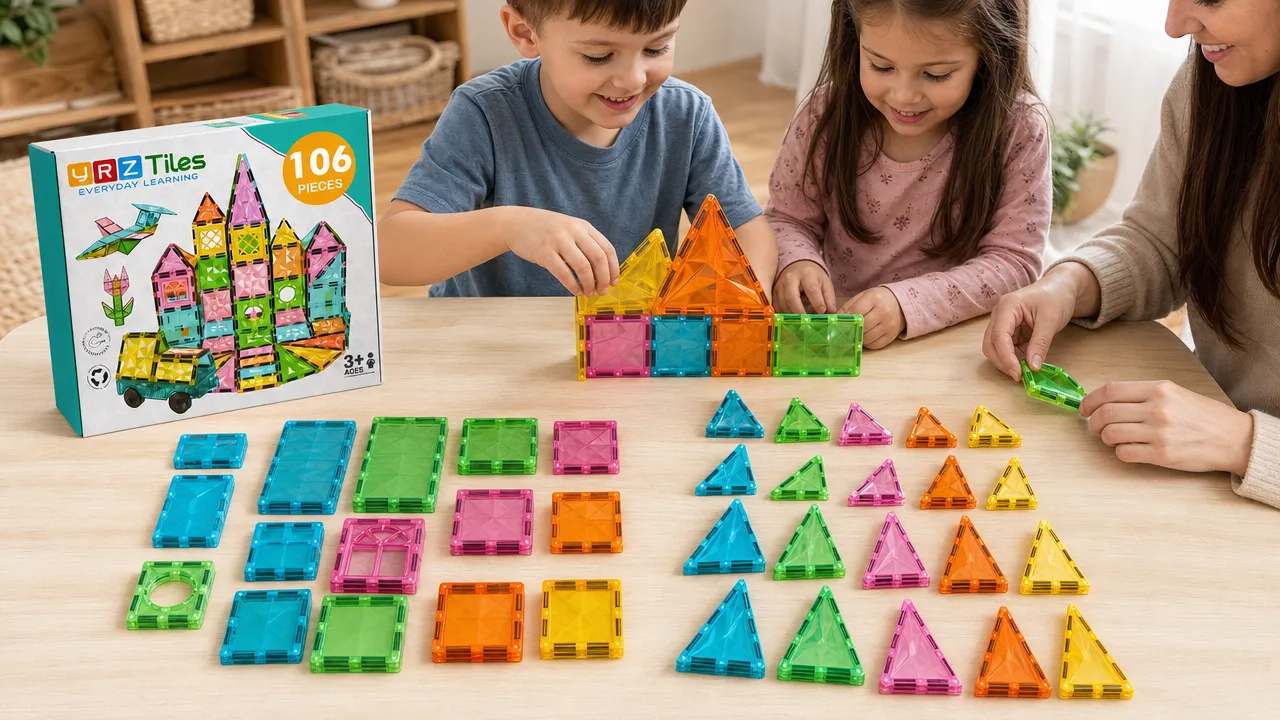
The architecture pieces are what make this Classic set especially useful for children who want a structure to have a recognizable purpose. The documented inventory includes six open square/frame pieces, four double-door panels, and six window squares across round, arched, and gridded designs.
Give each opening a story
Families looking for ways to use window and door magnetic tile pieces can start with storytelling instead of a complicated blueprint. A double-door panel may visually mark the entrance to a school, station, shop, castle, house, or market stall. Window squares can help children distinguish one building from another.
For example, children might decide that:
- Round-window squares belong on an observatory, boat-inspired building, or castle facade.
- Arched-window squares belong on a tall tower section or fantasy building.
- Gridded-window squares belong on an apartment, library, school, or storefront.
- Open square/frame pieces create a visual opening, display space, or wall detail.
The double-door panels are documented architectural panels, but they should not be described as hinged, swinging, locking, or functioning doors. Similarly, the frame pieces are best called open square/frame pieces rather than confirmed doorframes.
Try different window styles on a castle
For a castle window idea, try assigning each window style a visual role. Place arched-window squares on tower-like sections, use round-window squares on a central facade, and position gridded-window squares along side walls. Add triangles above square sections for a more pointed skyline.
This is one possible design approach, not a promise that every configuration will remain upright. If a structure shifts or falls, children can revise the base, reduce the height, or change the roof arrangement.
Turn the inventory into a small community
This inventory also supports small-scene play. Instead of trying to construct an entire city, choose two or three destinations and let children decide what each one does.
Choose a few community destinations
For community-building ideas, start with questions:
- Where do people live?
- Where do they get food?
- Which place needs an entrance?
- Which building needs a special window?
- Where might the one chassis travel?
A small community might include a house, a library, and a store. Standard squares and rectangles can outline building sections, while door panels and window squares make each destination easier to identify in a story. The single chassis can take one role, such as a visitor or delivery vehicle, without suggesting the set includes multiple cars.
Build a simple market stall
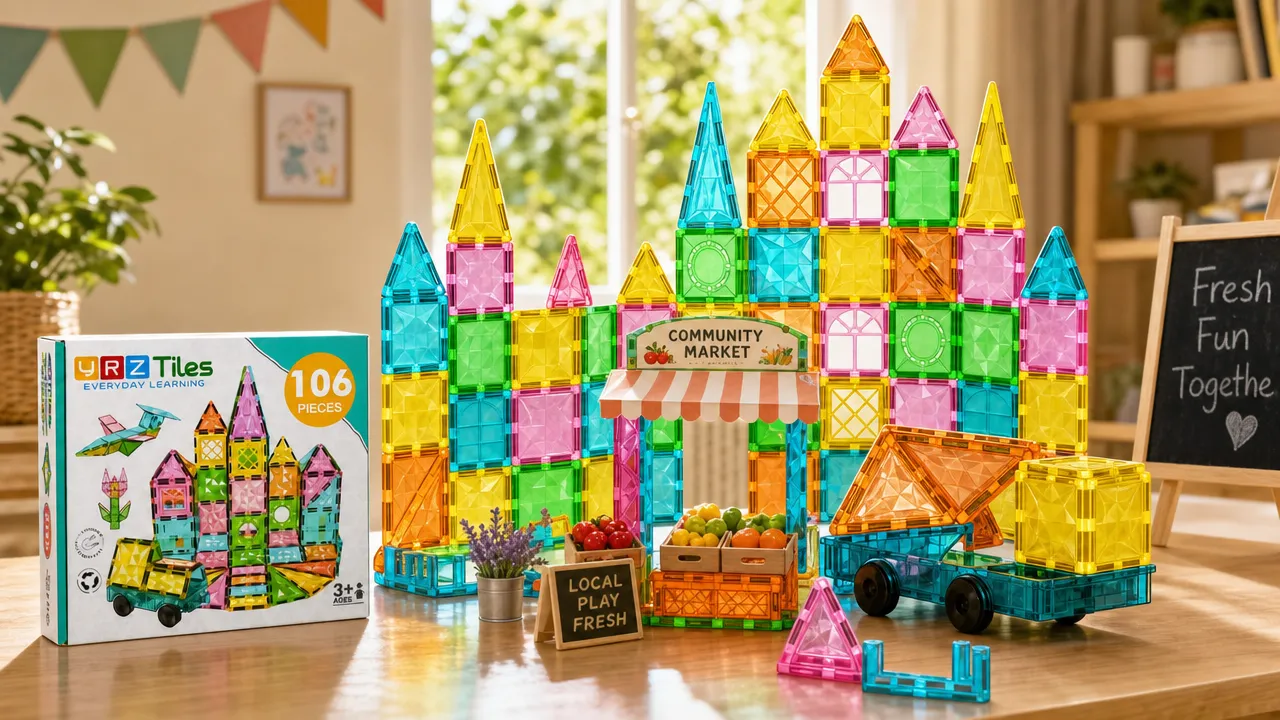
A simple market-stall scene can be built with a low, open-front structure. Build a low, open-front structure with square sides and a rectangle used as a counter-like visual surface. Add a double-door panel or frame piece as an entrance marker, then use a window tile as a display detail.
Invite children to choose what the stall sells and who comes to visit. Paper signs, toy food, baskets, trays, toy figures, and cardboard bases are optional and not included. Adults should choose any extra materials that are appropriate for the children playing.
Use the wheeled chassis for gentle tests
The set includes one wheeled chassis, not multiple vehicle bases. That one component can be a useful starting point for a gentle build-test-adjust activity on a flat play surface.
Check a garage-style opening without guessing
There is no published dimension for a garage-style opening, door panel, or chassis route in the product material. Use a relative planning method instead:
- Place the included chassis on a flat surface.
- Build a low garage-inspired opening with squares, rectangles, frames, or door panels.
- Gently move the chassis toward the opening.
- If it catches, adjust the opening by changing the arrangement.
- Recheck the path before adding a roof or extra details.
This approach encourages observation without claiming that the door panels create a working garage door or that the chassis will pass through every design.
Try a bridge route with the chassis
To explore whether the chassis can pass beneath a bridge, make a small experiment rather than a strength claim. Build two short supports, add a tile span or arch-like arrangement, and gently test whether the single chassis can approach, travel beneath, or travel across the design.
Use questions such as: "Where did it touch?" and "What should we change first?" Do not use tile structures to hold household objects, body weight, or heavy loads.
Safety notes and common questions
Safety note: For Ages 3+. Inspect magnetic tile pieces before play. Stop using cracked or separated pieces, or any piece with an exposed or missing magnet. Keep magnet-containing pieces away from younger children. If magnet ingestion is suspected, seek immediate medical attention. These steps do not replace official product instructions, medical advice, or product-safety guidance.
The U.S. Consumer Product Safety Commission magnet safety guidance warns that swallowed magnets can cause serious injuries. Keep pieces accounted for during cleanup, especially after group play.
Does this set include windows and doors?
Yes. The inventory includes two round-window squares, two arched-window squares, two gridded-window squares, and four double-door panels. Their visual designs are documented, but operating windows or doors are not.
How many wheeled chassis are included?
One wheeled chassis is included. It can be used for one vehicle-inspired model or one clearance experiment at a time.
Is the 106-piece set the same as MagFlake?
No. The 106-piece set is part of the Classic magnetic tile system. The 58-piece MagFlake set is a separate hybrid system. Do not assume that MagFlake features, inserts, decorative accessories, or interlocking-slot functions apply to the Classic set.
What is the best way to use the parts list?
Sort the pieces first, choose a small build idea, and keep the specialty pieces visible. This helps children decide whether they want to make a roof, entrance, window detail, boundary, or a chassis path before using all the core squares and triangles.
This documented inventory shows more than a total count. It documents a flexible mix of 30 standard squares, 45 triangles, 10 rectangles, architecture pieces, and one wheeled chassis. For Ages 3+, it can be a practical starting point for child-led building, testing, storytelling, and redesign. To review the current product directly, visit the YRZtiles 106-piece Classic magnetic tile set or browse all YRZtiles products.