

How to Divide a 100-Piece Magnetic Tile Set for Group Play
Use a personal starting pile plus a community build pile to divide a 100-piece set. This approach to sharing a magnetic tile set gives each builder enough pieces to begin while reserving pieces for a shared road, bridge, roof, or final connection.
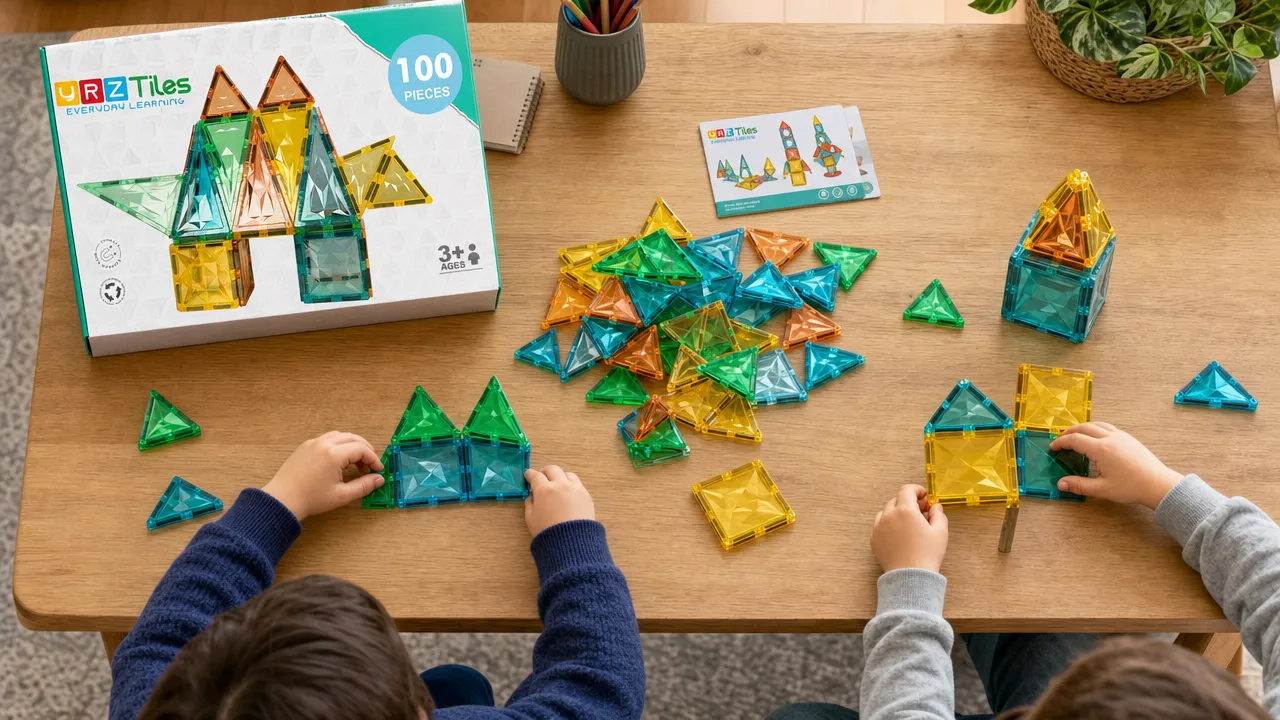
Agree on the plan before opening the pile
Prepare the play surface before opening the full pile. Mark one build zone for each child and place the community build pile in the center.
Use optional household materials to define zones:
- Placemat-sized paper sheets.
- Paper name labels.
- Shallow trays or small baskets.
- A strip of masking tape on a table.
- Folded towels for floor play.
These materials are optional household supplies. They are not included product features.
State the rules before distributing pieces:
- Pieces inside a child's zone belong to that child during the first building phase.
- Pieces in the center belong to the group.
- Ask before taking from another zone.
- Trade, do not grab.
- The first chooser rotates at the next session.
Use a short script: "Your pile starts your build. The middle pile is for the part we make together."
Fairness does not require every child to receive the same shapes or colors. Use equal counts, turn-taking, and access to the shared reserve. If a child receives a less-preferred piece, give that child an earlier selection turn when the reserve opens.
Choose a fair way to share 100 pieces
Choose the split based on the number of builders and the goal of the activity. Use more personal pieces for separate builds. Use a larger community reserve when the group will create one connected scene.
| Builders | Personal starting piles | Community build pile | Best use |
|---|---|---|---|
| 2 | 50 and 50 | 0 | Separate builds that connect later |
| 2 | 45 and 45 | 10 | A magnetic tile set for two children building with a shared bridge, road, or roof |
| 2 | 40 and 40 | 20 | One larger cooperative project |
| 3 | 30 each | 10 | Default three-builder setup |
| 3 | 25 each | 25 | Shared town, castle, or neighborhood |
| 4 | 25 each | 0 | Four separate builds |
| 4 | 20 each | 20 | Default four-builder setup |
| 4 | 15 each | 40 | One group scene with a large shared structure |
For two builders, start with 45 pieces each and keep 10 pieces in the center. This split provides substantial personal piles while leaving a clear reason to cooperate.
For three builders, use 30 pieces per child and 10 shared pieces. This avoids giving one builder an extra piece. The remaining 10 pieces become a defined group resource.
For four builders, use 20 pieces per child and 20 shared pieces when cooperation is the priority. Use 25 pieces each if the children prefer independent builds.
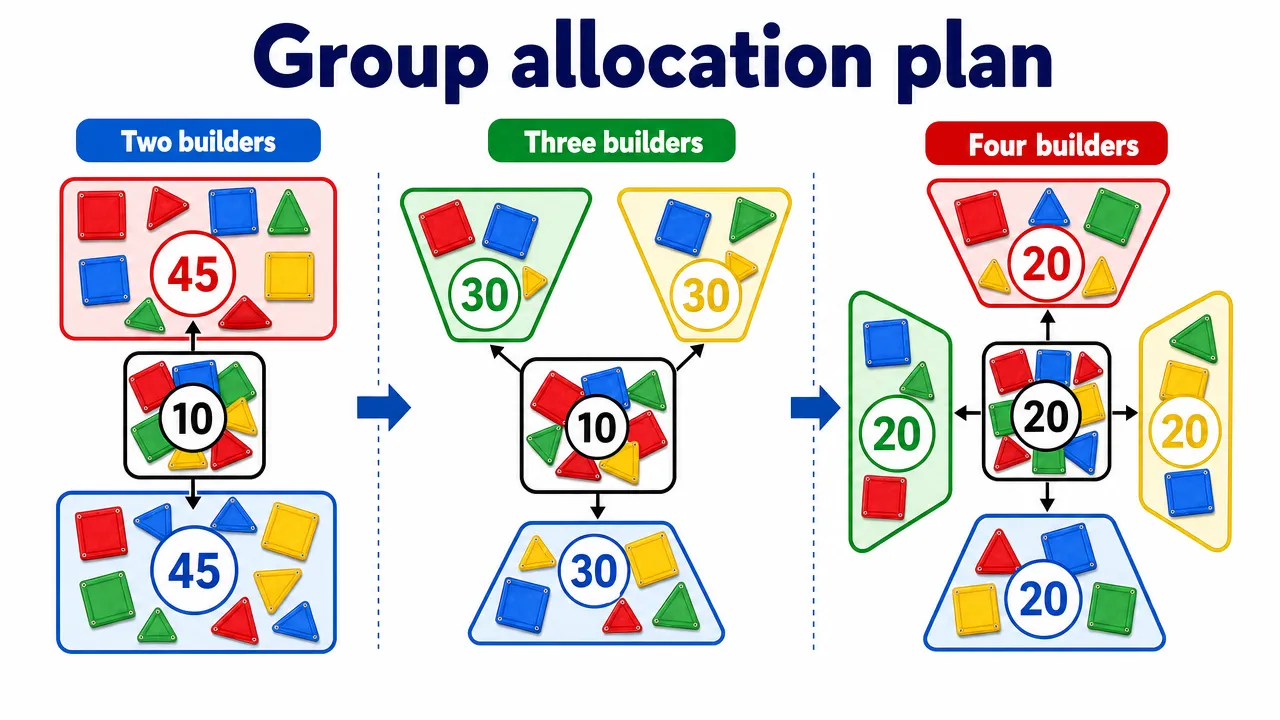
Three simple ways to start
Use one distribution method for the entire session. Changing methods midway can create arguments about who had more choices.
Take turns choosing
This method makes the allocation visible.
- Mix all pieces face up in the center.
- Choose a first picker.
- Each child selects one piece per turn.
- Continue until every personal pile reaches its assigned count.
- Leave the planned reserve in the middle.
- Rotate the first picker at the next play session.
For a 30/30/30 plus 10 setup, three children take turns until each has 30 pieces. Leave the final 10 pieces untouched in the community pile.
Deal equal counts from a mixed pile
This method is faster when an adult is setting up the activity.
- Mix the pieces.
- Deal one piece at a time to each builder.
- Continue until every builder reaches the assigned count.
- Check each pile for a workable variety.
- Swap one or two pieces by agreement if a pile seems unusually limited.
- Place the remaining pieces in the community pile.
Do not promise identical shape mixes. The goal is an equal starting count and a usable selection process.
Build the shared foundation first
Use part of the community pile before personal builds begin.
Assign the group one shared feature:
- A road.
- A bridge entrance.
- A castle wall.
- A town square.
- A garden boundary.
- An animal-shelter entrance.
- A garage floor.
Use 8 to 12 community pieces for this feature. Keep the remaining reserve available for later connections.
Give every builder a connected job
Plan the project by dividing the work into connected sections. Assign each child a zone or feature instead of assigning a winner.
Use the separate-first, connect-later procedure:
- Give each child a personal starting pile.
- Set a first building phase of 10 to 15 minutes.
- Ask each child to create one structure in their own zone.
- Open the community pile after every child has a starting structure.
- Add connectors between structures.
- Finish with one shared feature.
Use prompts that require multiple contributions:
- Build a neighborhood with homes, a park, and one road.
- Create an animal shelter with separate areas and a shared entrance.
- Make a castle with individual towers connected by walls.
- Design a garage with separate bays and one central entrance.
- Build a rescue station with a shared meeting area.
- Make a pretend city where each builder controls one area.
Avoid prompts based on height, speed, or comparison. Do not use "Who can finish first?" or "Whose build is best?" Use shared milestones instead:
- "Can every structure connect to the town square?"
- "Can the bridge reach both sides?"
- "What does the group build need before visitors arrive?"
- "How can we connect all four areas?"
Rotate roles every few minutes when the group is making one large build.
| Role | Assigned task |
|---|---|
| Architect | Names the next shared feature |
| Builder | Attaches pieces to the group structure |
| Connector | Links two separate sections |
| Piece finder | Searches the community pile for a requested piece |
| Cleanup counter | Counts returned pieces with an adult |
Rotate the role, not ownership of the project. Every child should still be able to add ideas and pieces.
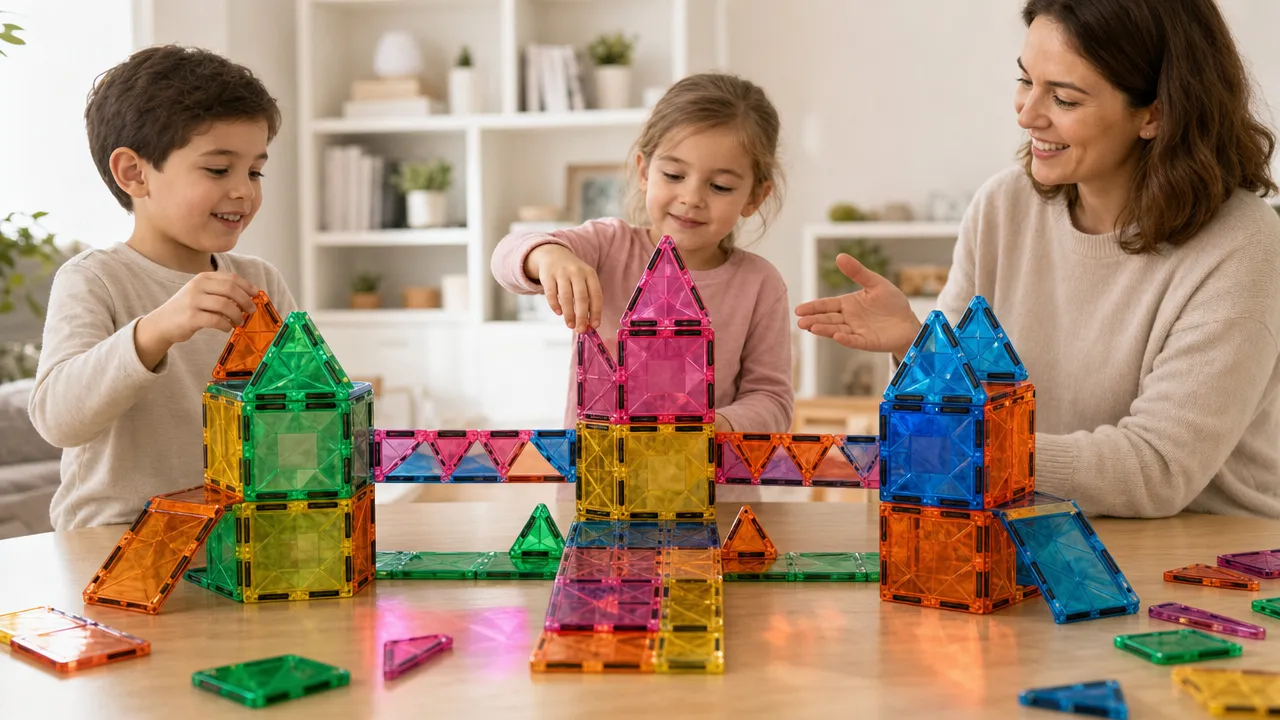
Finish with a count and a reset
End each session with a count. Cleanup counting helps locate missing pieces before children leave the play area.
Use this 100-piece routine:
- Ask every builder to place loose pieces in one collection area.
- Assign one child as the cleanup counter.
- Count aloud in groups of 10.
- Form 10 piles of 10 pieces.
- Confirm that the total is 100.
- Check each personal zone and the floor if a piece is missing.
For the four-builder 20/20/20/20 plus 20 setup, each child returns 20 pieces from their zone. Count the final 20 shared pieces as a group.
A YRZtiles 32pcs STEM Magnetic Tiles and Building Blocks set has 68 fewer pieces than a 100-piece set. For a 32-piece activity, keep the prompt compact: make a small shelter, create a flat pattern, or take turns adding one piece at a time. Smaller-set challenges work best when the rule limits the number of pieces used instead of requiring a specific shape.
When comparing 32 and 100 pieces, look at sharing capacity rather than storage dimensions. A 100-piece set can support personal piles plus a reserve. A 32-piece set has fewer pieces to distribute among multiple builders.
When comparing the 32-piece and 106-piece Classic sets, treat them as separate configurations. The YRZtiles 106pcs STEM Magnetic Tiles and Building Blocks set has documented architecture pieces and one wheeled chassis. Do not treat it as the 100-piece Classic set plus six defined pieces.
The 100-piece Classic and 58-piece MagFlake products should remain separate systems. The MagFlake - 2 in 1 Magnetic Tiles 58Pcs Set is a distinct hybrid system with magnetic edges and interlocking slots. Do not assume cross-system interchangeability or transfer MagFlake features to Classic magnetic tile sets.
Safety and cleanup
Use magnetic tiles according to the current Ages 3+ guidance. Inspect pieces before and after play.
Stop using any piece that is cracked, separated, or has an exposed or missing magnet. Keep magnet-containing pieces away from younger children. Do not allow chewing, mouthing, throwing, or opening pieces.
Count pieces after group play. If magnet ingestion is suspected, seek immediate medical attention. Review the U.S. Consumer Product Safety Commission magnet safety guidance and its magnet ingestion safety handout for additional information.
A fair split does not need identical shapes in every pile. Use equal starting counts, a visible community reserve, turn-taking, and cleanup counting. This sharing routine can be repeated for two, three, or four builders with the YRZtiles 100pcs STEM Magnetic Tiles and Building Blocks.