

32-Piece vs 106-Piece Magnetic Tiles: Starter Set or Specialty Builds?
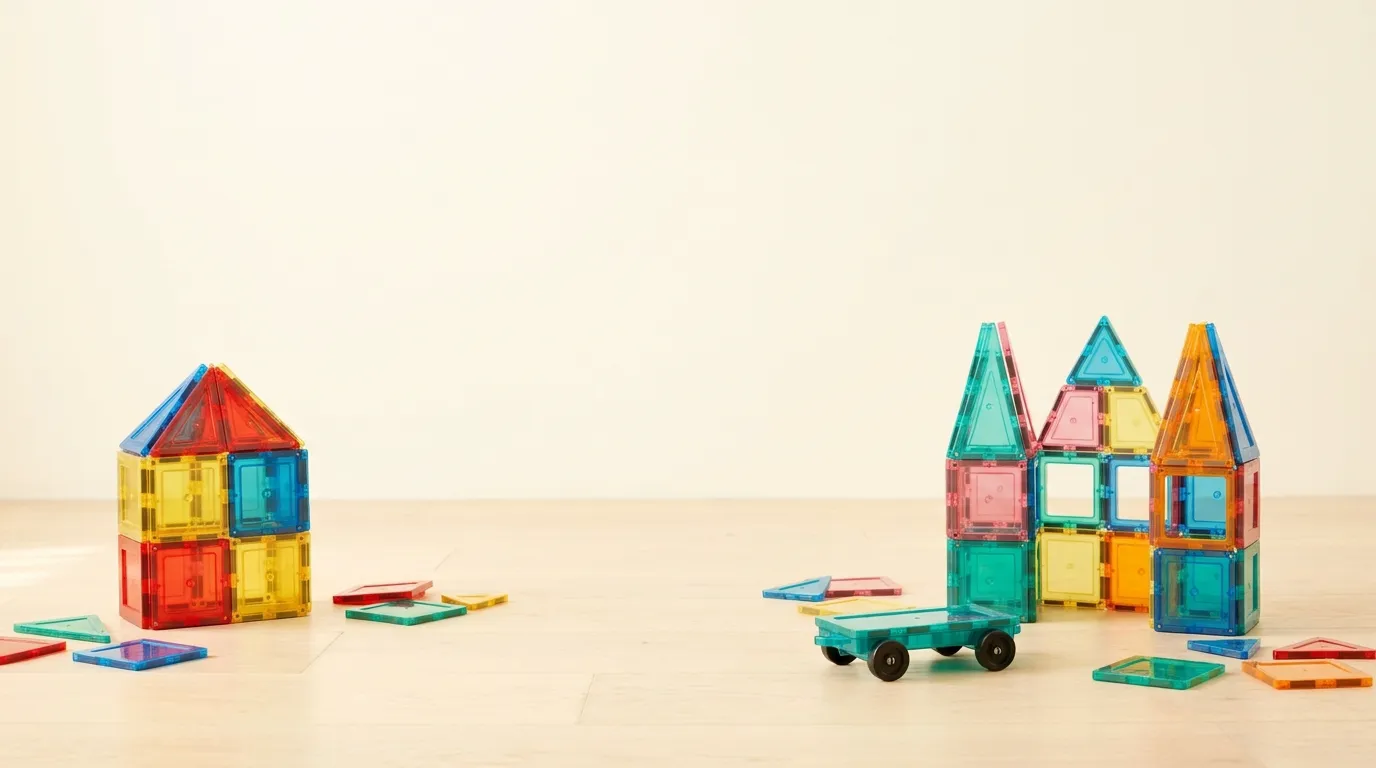
A smaller set can make a short building session feel clear and satisfying. A larger set leaves more room for the story to grow.
For most families, the choice between 32 and 106 pieces comes down to how children like to play. The YRZtiles 32pcs STEM Magnetic Tiles and Building Blocks works well as a practical first set for one child and shorter, focused playtimes. The YRZtiles 106pcs STEM Magnetic Tiles and Building Blocks gives families more room for architecture, shared scenes, and vehicle stories.
The 106-piece set has 74 more pieces than the 32-piece option—about 3.3 times as many—and includes one car chassis. That difference is most noticeable when a child wants to keep a base intact while adding another part of the story.
The Quick Comparison
When you're trying to figure out if the 32-piece or 106-piece magnetic tile set is best for your family, it's helpful to think about a few things: how many children usually build at once, how long their projects tend to stay assembled, and whether your child enjoys quick, experimental builds or loves diving into detailed scenes.
| Everyday need | 32-piece set | 106-piece set |
|---|---|---|
| First magnetic tile purchase | A solid start | Good if you suspect bigger projects are on the horizon |
| One child and short play sessions | A great fit | Might be more than some families need |
| Two children building at once | Good for a small, shared idea | Often a better starting point |
| Larger buildings and multi-part scenes | Might mean a lot of rethinking and rebuilding | Offers more room for solid bases, extra parts, and fixes |
| Vehicle-oriented storytelling | Kids can get creative and make car-like shapes | Comes with one car chassis already included |
| Compact setup and cleanup | Easier to keep contained | A wider play area and sorting spots are helpful |
A smaller set is not automatically less creative. In fact, sometimes having fewer pieces encourages a child to focus on a goal, simplify their idea, and then adapt if their structure changes. The larger set simply provides more room to build; a child can leave their base intact while adding a roof, another room, or continuing their story in a new direction.
Planning for Two Children
When you’re looking for a magnetic tile set for two children, the 106-piece option is generally the most practical choice. It gives each child more freedom to build on their own, add a section to a shared creation, or start independently and then connect their projects later on.
Even the 32-piece set can be great for cooperative play, especially when you set a clear boundary for the activity. Think of it more as a set for one small, focused mission rather than two big builds happening at the same time. Cooperative options include taking turns adding to a tower, creating a flat picture together, or having one child build the base while the other designs the roof.
How to Share the Larger Set
If you're thinking about how to share out 100 magnetic tiles for group play, it's good to use the 106-piece set as a general guide rather than expecting an exact, identical mix of shapes for everyone. The set comes with 106 pieces, plus that one shared car chassis.
A simple way to divide things up could be:
- Give one child a generous starting pile of about 40 pieces.
- Give the other child a generous starting pile of about 40 pieces.
- Keep about 25 pieces aside for a shared pool, good for repairs and adding little details.
- Leave the one car chassis in the shared area, ready for turn-taking or a joint story.
Fairness doesn’t always mean every child gets the exact same shapes. It can mean taking turns choosing first, having equal access to that shared pool, and agreeing on a plan before a favorite piece causes a little dilemma.
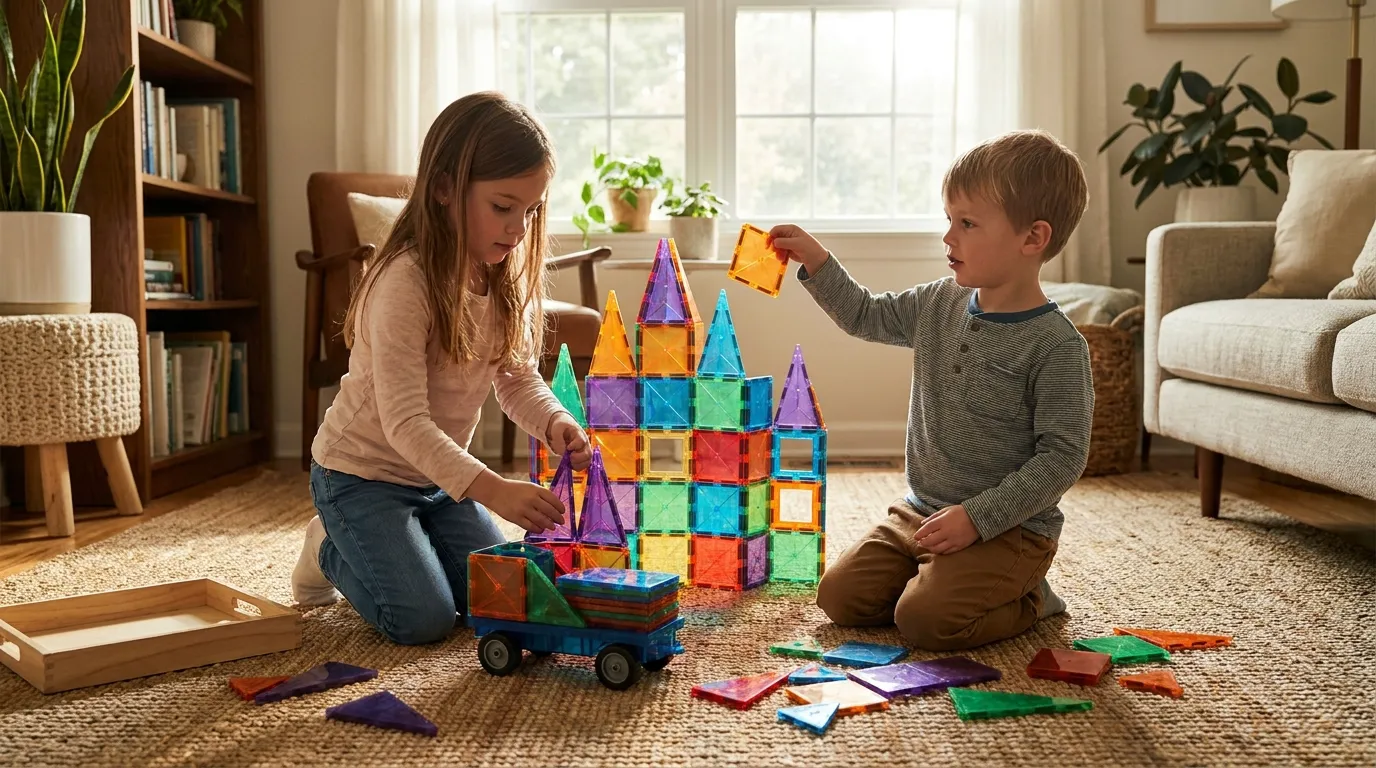
For three or more children, it's often helpful to shift from independent projects to working in teams or setting up different building stations. One child might focus on designing an entrance, another could create a tower, and a third might make a road or the surrounding scene. Open-ended building like this can spark rewarding opportunities for working together and using spatial language. You can offer prompts like, "How could you make this wider?" or "What's a good way to connect these two parts?" The National Association for the Education of Young Children has some helpful ideas on block play and collaboration.
Ideas and Challenges for 32 Pieces
When you hear "32-piece magnetic tile set building ideas," it doesn't have to mean building one big, complicated model. A smaller set works well when the prompt is visual, a bit limited, and easy to reset.
Here are some adaptable ideas you can try with the 32-piece set:
- Create a flat fish, a rocket, a flower, or a face.
- Build a tiny home or a little shelter and talk about who might use it.
- Make a low bridge between two supports.
- Design a symmetrical pattern, then invite someone else to complete the other side.
- Instead of one huge building, try designing two or three small neighborhood spots.
- Build a short tower, and when it tumbles, try changing the base before building it taller again.
Compact Building Challenges
These magnetic tile challenges, using just 32 pieces, can turn the limited number of pieces into part of the fun:
- Ten-piece tower: Try to use no more than 10 pieces. If it collapses, change the base a bit before trying to make it taller.
- One-shape rule: Pick just one type of shape from your set and use only those to make a flat design or a small structure.
- Build, swap, add: Each person makes a small build, then swaps with a partner. The goal is to add just one more piece without taking apart the original core.
- Symmetry detective: One person makes half of a design. The other person then completes the mirror image.
- Architect and builder: One child describes a small design using words like "beside," "above," and "under." The other child builds it, and then they switch roles.
- Repair, not restart: Make a gentle change to an existing structure and try to improve it using only three additional pieces.
These are not tests. The value is in the planning, talking through ideas, trying a different approach, and deciding what to do when the first idea does not work out. As adults, we can support this process by using simple spatial words like "turn," "between," "near," and "farther." This is an approach that's also encouraged in NAEYC's guidance on spatial thinking.
Plan Larger and More Specialized Builds
When you're planning big builds with 100 magnetic tiles, it’s often best to avoid putting every single piece into one tall structure right away. The 106-piece set works well when you think about building in sections: start with the foundation, then add connected areas, and finally, the finishing details.
A practical way to approach the 106-piece set might look like this:
- Choose one shared theme together, like a little town, a station, a garage, a castle-like structure, or a house.
- Clear a central spot for the main base.
- Assign different sections, maybe an entrance, a roofline, a road, a tower, or a parking area.
- Hold back a small number of pieces – these will be handy for repairs and adding those final touches.
- Connect the sections once each part feels stable enough.
- Decide together when and how to use the one car chassis in your shared story.
Having that larger number of pieces is especially helpful for children who like to keep a structure intact while they experiment with new ideas. Instead of having to take down a wall to create a roof, they might have enough extra pieces to try out both ideas. That’s what makes the 106-piece set such a strong choice for scenes inspired by architecture and for vehicle-focused play.
Space, Cleanup, and the Final Choice
The question of how much space you need for 32 vs 100 magnetic tiles comes down to how much visual spread you're comfortable with, your sorting preferences, and whether your family typically leaves active projects out for a while. This comparison focuses on the available 32-piece and 106-piece YRZtiles sets, but the practical space considerations are pretty similar across the board.
| Setup consideration | 32-piece set | 106-piece set |
|---|---|---|
| Best starting area | A tray, a small table, a coffee table, or a defined mat | A larger table or a clear spot on the floor |
| Loose-piece organization | Most pieces can stay visible and accessible | A sorting zone or some shallow bins are a good idea |
| Active project style | Quick builds that are easy to reset and try again | Multi-stage projects that might stay assembled for a bit |
| Cleanup routine | Simple gathering and counting | Gathering, a quick look-over, counting, and storing with a simple routine |
For the smaller set, a tray or even a compact tabletop can help define the play zone, making cleanup feel much more manageable. With the larger set, it's often helpful to set up three simple areas: one for the active build, one for the available pieces, and that shared pool for repairs and details. It's also a good idea to keep any in-progress builds away from busy walkways, food, drinks, pets, and very young children.
Which set should you choose?
You might lean towards the 32-piece set if you are:
- Buying a first set for one child.
- Working with a small table or anticipating shorter play sessions.
- Looking for compact challenges, flat designs, and builds that are quick to reset.
- Giving a gift and aren't sure how often the child will build with them.
You'll likely find the 106-piece set a better fit if you are:
- Buying for two children who often play together.
- Getting ready for playdates or shared family building time.
- Supporting a child who enjoys making bigger buildings, detailed scenes, or longer projects.
- Looking for a set that includes one car chassis for those vehicle-themed stories.
If your family starts with the smaller option and later wants more flexibility for building, you can always explore the YRZtiles Classic magnetic tile collection. For more inspiring play ideas for your family, do check out the YRZtiles blog.
The simplest way to think about it is this: choose 32 pieces for focused, contained starter play, and choose 106 pieces when your family needs more room for two different ideas, bigger scenes, and those special, intricate builds.