

100-Piece Classic vs 58-Piece MagFlake Magnetic Tiles: Which Play Style Fits?
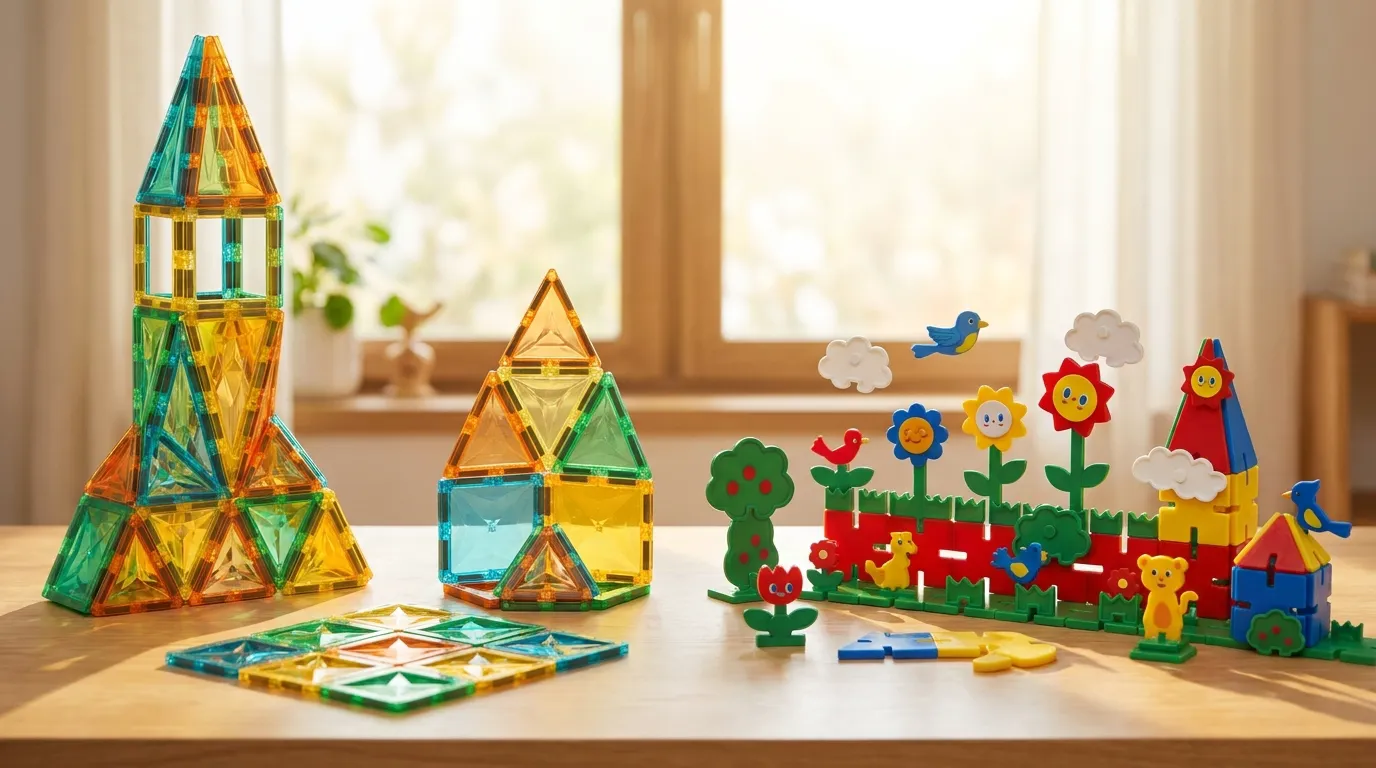
Does your child usually start by building a tower, or by creating a world for a story?
When you're choosing between a 100-piece Classic set and a 58-piece MagFlake set, it’s less about which box has more pieces and more about what invites your child to play. One supports broad, geometric construction that can grow over time. The other combines building with decorative, scene-oriented elements that can spark a setting or story.
Both sets are labeled for ages 3 and up in their current product materials. The real question for us as parents is: Will your child be happier expanding a structure, or arranging all those rewarding details that give a build a story?
Start with Play Style, Not Piece Count
Piece count matters, but it is not the whole picture. A larger shared pool of tiles can make it so much easier to keep a collaborative build going smoothly. On the other hand, a set that's more focused on creating a scene can make it simpler to give each child a meaningful role in one shared activity.
The YRZtiles 100pcs STEM Magnetic Tiles and Building Blocks set is a Classic geometric magnetic construction set. It uses familiar geometric tile shapes for open-ended building. With 100 pieces, it gives children room for flat designs, freestanding structures, connected buildings, and longer construction sessions.
The MagFlake - 2 in 1 Magnetic Tiles 58Pcs Set takes a completely different path. It blends magnetic construction with insert cards and decorative accessories, all through what they call the MagFlake "Snap AND Stick" play system. This combination gives children more visual starting points, whether they’re building a garden, an animal habitat, a weather scene, or some entirely invented world.
It’s good to think of these systems as distinct. This comparison isn't assuming their pieces connect together, or that you can transfer them between sets, or even that they’ll perform in the exact same way.
| Decision factor | 100-piece Classic | 58-piece MagFlake |
|---|---|---|
| Primary entry point | Geometric building from shapes | Construction plus visual scene-making |
| Best for | Expanding structures and open-ended builds | Story settings, decorative details, and prompts |
| Shared-play approach | Separate starting areas or one large connected project | One cooperative scene with defined roles |
| Piece-pool flexibility | More room to reserve pieces during a build | More contained overall pool |
| Cleanup consideration | More pieces to gather and sort | Fewer total pieces to gather, without making a storage claim |
Notice How Children Begin a Build
Some children see a square and immediately ask, "What can I build?" Then others spot a lion, a moon, or a flower and their first thought is, "Who lives here?" Neither approach is better. They simply begin play in different ways.
Open-ended geometric building
Choose the Classic 100-piece set when your child loves trying out shapes, building towering structures, making little houses, adding rooms, or even coming back to the same project throughout an afternoon. That larger pool of pieces gives them so many more options to tweak a base, add some impressive height, or build several connected sections.
It can be especially helpful for families who enjoy planning those bigger builds with their 100 magnetic tiles. Instead of seeing every single piece disappear into one tall tower right away, you can gently encourage a simple sequence:
- Start with a nice wide base.
- Maybe set aside some pieces for walls or roof sections.
- Then, add a second structure or a connecting bridge.
- Use the remaining pieces for flat patterns, little signs, or a surrounding neighborhood.
Now, this isn't a promise that every child will build a specific model, of course. But it’s a practical way to help the build last a bit longer, so it doesn't end too soon because every piece was used up in the first section.
Guided scenes and storytelling
Choose the MagFlake 58-piece set when your child responds well to a gentle nudge or just loves arranging all those visual details. Its decorative and nature-oriented pieces give a parent or caregiver a natural way to start play with a question instead of an instruction:
- Can you build a place for the animal before nighttime?
- Where should the sun go in this scene?
- Can the garden have a fence and some flowers?
- What happens when the moon comes out?
This kind of guided play still leaves the child in charge. You, as the adult, offer an idea and then follow your child’s lead. There's no need to assume insert cards or activity cards come with the 58-piece set. Those simple spoken prompts are often more than enough to get things started.
Compare Sibling and Group Play
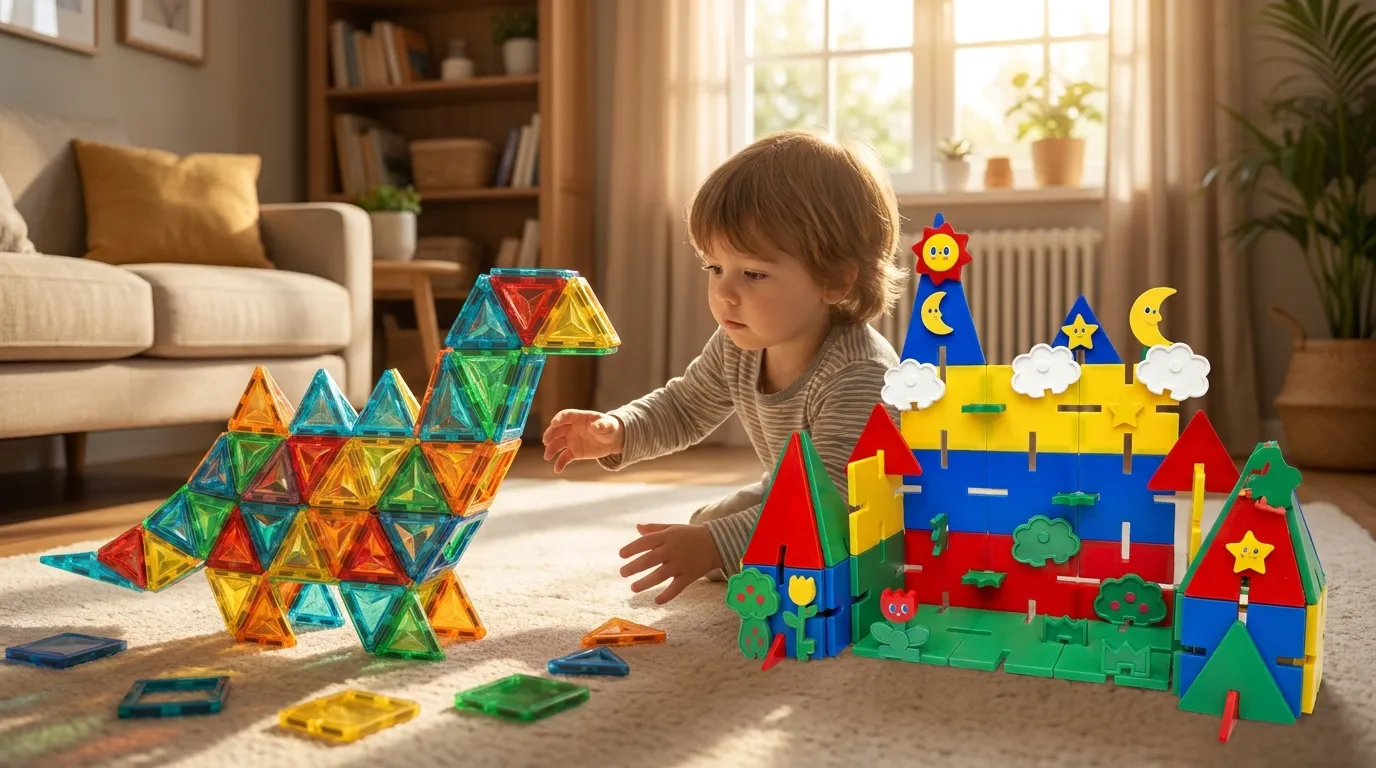
Deciding on the best magnetic tile set for two children often comes down to whether both want to make their own separate creations or if they’d prefer to build one shared setting together.
For two children who both love building structures, the 100-piece Classic set gives you more flexibility for planning. One child can start a house while the other constructs a tower, and you can still have a small shared reserve of pieces in the middle. That shared pile helps ease that feeling that every last piece belongs to just one builder.
If you’re trying to divide 100 magnetic tiles for group play, try not to get too hung up on splitting the total into perfectly equal numbers. The mix of shapes impacts what each child can do, and exact shape counts aren’t usually published for these sets. A gentler approach is to try and give each child a similar variety of available shapes where you can, and then leave a community pile for the pieces both builders might want.
For three or four children, a role-based build usually runs more smoothly than managing separate piles:
| Role | Practical contribution |
|---|---|
| Base builder | Creates the foundation or flat layout |
| Structure builder | Adds walls, towers, or connected sections |
| Pattern designer | Makes windows, paths, or flat geometric designs |
| Detail planner | Decides how to finish and connect sections |
The MagFlake set can work wonderfully for small-group play when everyone is contributing to one scene. One child might enjoy arranging the setting, another could place the decorative elements, and another might just love inventing the story that unfolds. Since the set has 58 total pieces, it’s generally more realistic to plan for one shared creation rather than trying to resource several separate structures.
It’s always a good idea to keep the work area clear and give it some defined edges with a rug, a tray, or just a dedicated table space. At cleanup time, counting pieces together can be a nice ritual. This is especially helpful after playdates, when pieces seem to have a way of traveling under furniture or into another activity area. For more activity ideas, you can always browse the YRZtiles magnetic tile planning and activity guides.
The chart simply shows a difference in piece count, not a ranking. More pieces naturally create a larger construction pool, while MagFlake’s play identity is also strongly shaped by its unique decorative and slot/interlocking elements.
Match the Set to Your Play Space
A smaller Classic set is useful for shorter, more contained activities. A compact set can work well for flat pictures, a small house, a simple tower, shape sorting, or a fun build-with-a-limit challenge.
The YRZtiles 32pcs STEM Magnetic Tiles and Building Blocks set is a good option if you’re specifically looking for a smaller Classic format. It's not a substitute for either of the featured sets in this comparison. Instead, it offers a helpful way to understand what different piece counts can support.
When you're thinking about the space needed for 32 vs 100 piece magnetic tiles, try to consider your child's building habits rather than just assuming the 100-piece set always needs more room. A child who loves building tall towers might use a very small footprint. But a child creating a flat town, a long road, or a wide pattern could easily take over an entire table with fewer pieces.
The same logic applies if you're comparing a 32 vs 106 piece magnetic tile set. Just six extra pieces alone don't explain the practical play difference. Things like the shape selection, any specialty components, whether children build flat or tall, and if siblings are sharing—all of these affect the experience. The Classic product we're focusing on here has 100 pieces, not 106.
For play in a limited space, MagFlake might be a great fit for families who prefer a contained scene or a nice, brief parent-child activity. Even so, a 58-piece scene can certainly spread across a table if a child is designing a grand landscape. You can always use a tray for a more compact activity, or just choose a floor area when the story starts to grow.
Which Play Style Fits Your Family?
If you find yourself searching "100 piece classic magnetic tiles vs MagFlake magnetic tiles 58," here’s a little final guide to help you decide:
- Choose the Classic 100-piece set for a child who loves geometric structures, always wants to keep expanding a build, or regularly shares with a sibling or a playdate guest.
- Choose the MagFlake 58-piece set for a child who is drawn to animals, gardens, weather, decorative details, and story-based scenes.
- Choose Classic for a magnetic tile set for two children when it looks like separate builds or one larger connected construction project are most likely.
- Choose MagFlake for a shared family prompt when the goal is a cooperative scene, with each person adding a setting detail or a story event.
- Choose based on your household reality when gifting. Think about whether the child tends to build structures from shapes or invents characters and worlds around visual elements.
The "better" set is the one that naturally fits the way play already happens at home. A 100-piece Classic set gives more room to extend geometric construction. A 58-piece MagFlake set offers a different kind of invitation: build something, decorate it, and then decide what happens next.